
The charm of Puerto de la Cruz never goes unnoticed by those who dedicate a day of their holidays to exploring the city. Places such as Lago Martiánez, Plaza del Charco, and the fishing harbour make this northern enclave of Tenerife one of the island’s most beautiful corners. Yet there is even more to discover. Hidden among the buildings of the old fishermen’s quarter lies one of the most captivating routes to enjoy on the island.
Puerto Street Art is an urban‑renewal project linked to the renowned Mueca Festival, which every spring fills the streets of Puerto de la Cruz with colour and creativity through high‑value artistic interventions. These are stories told through magnificent murals created by internationally acclaimed artists. Puerto Street Art offers a delightful way to explore this part of the city, revealing an open‑air museum and inviting visitors to experience art from a fresh perspective.
A walk through murals of Puerto de la Cruz
Puerto de la Cruz is a tourist city that, among its many attractions, features nearly twenty striking murals signed by internationally recognised artists. Many of them are concentrated in the fishing district known as La Ranilla, forming a route through one of the liveliest areas of the municipality.
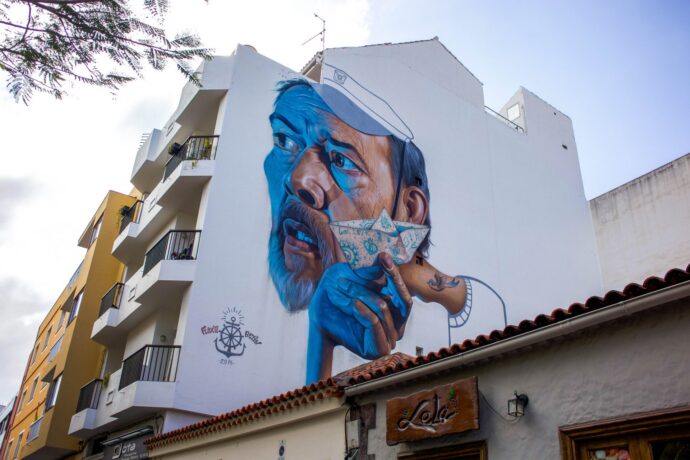
Enjoying the murals of Puerto Street Art is easy, comfortable, and highly recommended. The walking route can begin at the Tourist Information Centre (CIT) on Puerto Viejo Street, an area filled with charming corners and excellent restaurants, where the relaxed local atmosphere blends seamlessly with this colourful artistic trail.
Near the CIT stands the mural known as La Eterna Juventud, a work by the Andalusian artist Belin (Miguel Ángel Belichón), one of the world’s leading hyperrealist painters. His piece is among the most striking: the face of a sailor, rendered with extraordinary realism, symbolises the deep connection between the municipality and the sea since its origins as the port of the Orotava Valley. The sailor’s weathered face, marked by sun and salt, holds a small paper boat filled with references to travel and the wider world. It is a work worth admiring for several minutes to appreciate every detail.
Continuing down Teobaldo Power Street, the next mural appears: an untitled piece by the artist Kob. This elongated, abstract mural depicts surreal scenes, imaginary vegetation, and strange intertwined creatures. It is a work that sparks the imagination as viewers attempt to identify shapes within the dense composition of fantastical species.
Along the same street is a mural by one of the Canary Islands’ most celebrated artists, Sabotaje al Montaje, titled Ritual. It pays tribute to Chucho Dorta, a well‑known defender of Canarian traditions. Next to the freehand portrait of Dorta appears the face of a goat, referencing the traditional goat‑bathing ritual held each year at the fishing harbour of Puerto de la Cruz on the feast of Saint John.
The route continues along El Lomo Street, one of the most vibrant areas of the municipality, lined with appealing restaurants and adorned with several murals. On one side is Navíos volátiles by FEOFL!P: a wooden boat with a fish’s head and oar‑shaped wings sails across the world. The vessel bears the name Taoro, in memory of the ancient menceyato—one of the kingdoms into which Tenerife was divided before the conquest—to which Puerto de la Cruz belonged.
Next to the Archaeological Museum of Puerto de la Cruz stands the mural by Roa, arguably one of the most emotionally impactful works in the entire Puerto Street Art collection. The artist depicts a massive pyramid of insects climbing over one another, rendered with extraordinary detail on the side of a building.
Opposite Roa’s mural is El Viaje Inesperado by Liqen, one of the world’s leading graffiti artists. From the mouth of a clay jar with multicoloured wings emerges the head of a reptile. Liqen’s works often evoke curiosity about biology and the species that have survived thousands of years of evolution.
On Mequinez Street is La Frontera del Paraíso by Victor Ash, where a large mesh of black human silhouettes intertwines to form a fence that seems to block access to paradise, represented by a colourful sunset in the background. It is a reflection on how economic constraints and social prejudices can hinder the path to a better life.
Along the same street is La Macaronesia by Iker Muro, a vibrant, psychedelic surrealist piece. The artist describes his style as an acidic blend of pop elements.
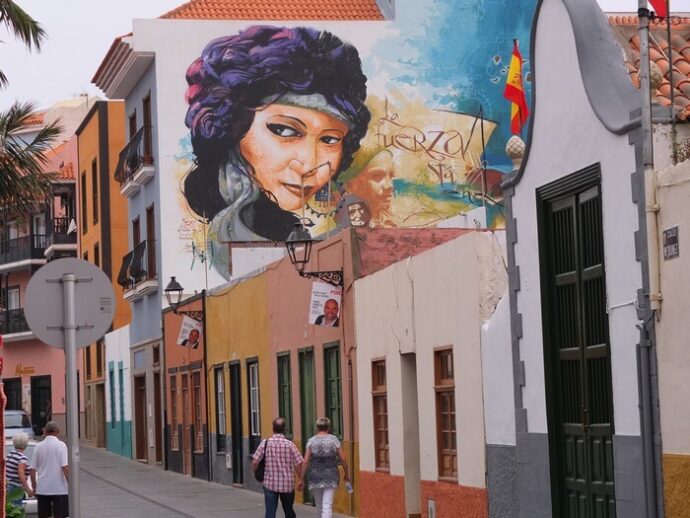
The next mural on this artistic walk through Puerto de la Cruz is La fuerza está en las raíces by El Niño de las Pinturas, a graffiti artist with more than twenty years of experience. The work is a tribute to Canarian culture, represented through the face of a woman surrounded by traditional elements such as pintaderas, a manta esperancera, and the hibiscus flower.
At this point in the route, the magic of Puerto Street Art blends with the colourful façades of the fishermen’s quarter through another beautiful initiative by local artist Juliana Serrano. Next to the doors of several houses, she has painted motifs such as fish, a hammer, or a mouse—symbols that reference the history and nicknames of the residents. It is a magnificent fusion of tradition and modernity in Puerto de la Cruz, and one not to be missed.
