
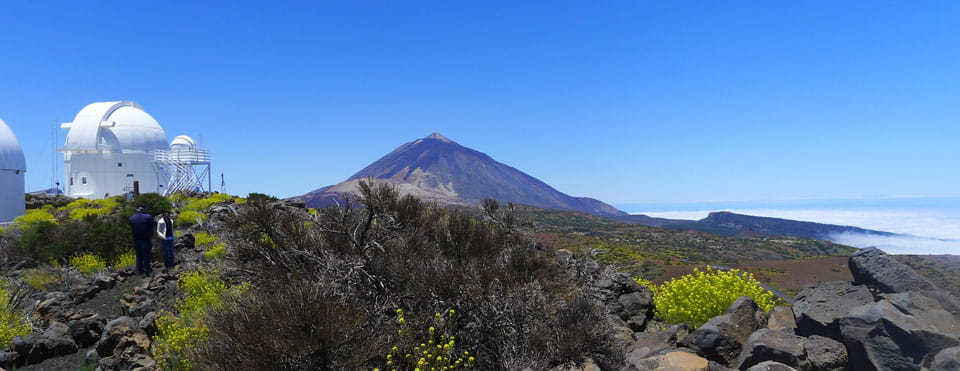
Teide Observatory
Observatory of Tenerife
Historic origins: The study of astronomy has always been closely associated iwith Mt. Teide. Its advantages as an observation post were well known by naturalists and astronomers centuries ago. Piazzi Smyth set up an observation post at 3,300 metres in the mid 19th century, taking advantage of the unbeatable potential of the skies of Las Cañadas
Lunar features were named Teide and Tenerife as a tribute to his work.
This astronomic tradition was continued in the early 20th century, with studies made of Halley´s Comet by French astronomer Jean Mascart in 1910 in Alto de Guajara, at an altitude of 2,718 metres. The importance of Las Cañadas as an outstanding platform for astronomic studies is reflected by the fact that the Mt. Teide Astrophysics Observatory was built at Izaña, where there has also been a weather station since 1916. The Mt. Teide Observatory - together with the Roque de los Muchachos Observatory, on the island of La Palma - belong to the CANARY ISLAND ASTROPHYSICS INSTITUTE (IAC, from its initials in Spanish), which has its head offices in La Laguna.
Modern Astrophysics took its first steps in the Canary Islands in this Observatory, in the early sixties, in the area of Izaña, at an altitude of 2,400 m, where the municipal boundaries of La Orotava, Fasnia and Güimar converge. The first telescope started to operate in 1964, to study zodiacal light, the light scattered by inter-planetary matter.
Area: 50 hectares
Altitude: 2.400 metres
Longitude: 16º30´5"West
Latitude: 28º18´00" North
Telescope Facilities: There are currently telescopes and other astronomic instruments from over 60 institutions of 19 different countries installed in the Mt. Teide Observatory (Island of Tenerife) and the Roque de Los Muchachos Observatory (Island of La Palma). These observation facilities, plus the scientific and technical facilities available in the IAC´s Astrophysics Institute in La Laguna (Tenerife) and in the IAC´s La Palm Common Astrophysics Centre in Breña Baja (La Palma), make up the European Northern Observatory (ENO).
Their geographic location, between the solar observatories of the east and the west, together with the transparency and excellent astronomic quality of the skies, have meant that the Mt. Teide Observatory gives priority to studying the Sun, concentrating the best European solar telescopes at these sites.
SOLAR TELESCOPES AND LABORATORY
Solar Vacuum Tower Telescope (VTT), 70 cm.
THEMIS solar telescope, 90 cm.
GREGOR solar telescope*, 1.5 m.
Solar Laboratory:
Spectrophotometers (MARK-I, IRIS-T, ECHO)
High resolution photometer TON
Fourier tachometer GONG
NOCTURNAL TELESCOPES
"Carlos Sanchez" infra-red telescope (TCS), 155 cm.
Mons reflector telescope, 50 cm.
IAC-80 telescope, 80 cm.
OGS telescope, 100 cm. (Optical Ground Station)
STARE telescope, 10 cm.
Bradford robot telescope *
STELLA robot telescopes*
COSMIC MICROWAVE BACKGROUND
33GHz interferometer
COSMO10 and 15
VSA (Very Small Array) interferometer network
(*) Not in operation yet.
Vacuum Tower Solar Telescope VTT
The Vacuum Tower Telescope belongs to the Kiepenheuer Institute of Solar Physics of Frieburg (Germany). It has a primary mirror with a diameter of 70 cm and a 15 metre long vertical spectrograph. It was installed in the Mt. Teide Observatory in the late eighties. This telescope enables astronomers to study the dynamics, structure and chemical composition of the solar atmosphere, and offers them the possibility of studying solar granulation trends. For this kind of observations, which require a high degree of spatial resolution, the telescope has a "Solar Correlator",an instrument that is unique in its class that was developed by the Canary Island Institute of Astrophysics.
Themis Solar Telescope
French astronomers have been interested in the Canary Island skies ever since Jean Mascart, of the Paris Observatory, visited the Canary Islands in 1910, to watch the passage of Halley0s Comet. In fact, the first telescope to be installed in the Mt. Teide Observatory belonged to the Observatory of Bordeaux.
The THEMIS (Heliographic Telescope for Studying Magnetism and Solar Instabilities) was designed by a team of French astronomers from the Observatory of Meudon-Paris. The THEMIS is now a Franco-Italian co-operation project.
With a diameter of 90 cm, THEMIS is the largest solar telescope of the Mt. Teide Observatory, and it is designed to measure the intensity and the direction of the solar magnetic field. One of the features of THEMIS is its ability to operate in several different bands at the same time, a characteristic that is essential for studies of this kind. Moreover, the THEMIS instrumentation provides experimental data on the structure of the solar atmosphere in 3 dimensions.
Visits to the Mt. Teide Observatory:
The educational work conducted by the Canary Island Institute of Astrophysics, to disseminate astronomic know-how to society, includes organised visits to the Observatory for schools and other groups. The Mt. Teide Observatory now has a Visitors´ Centre, created from an empty dome, which has been equipped for educational work. With a capacity for forty people, it is used to explain to school children what an observatory is, how the telescopes work and the importance of Astronomy for mankind.
Private visits: Because of reorganization, the programme of private visits to the Teide Observatory will suspended until September 2005.
Mt. Teide Observatory
Izaña
Tel: 34 / 922 329 110
Fax: 34 / 922 329 117
E-mail: teide@ot.iac.es
Web site: www.iac.es
Visits to the Institute of Astrophysics
Visits to the head offices can be arranged with the IAC Management Board
Canary Island Institute of Astrophysics
C/ Vía Lactea, s/n
38200 - La Laguna (Tenerife)
Telephone: 922 605 200 / 207
E-mail: aqg@ll.iac.es
Web site: www.iac.es
We answer to your frequently asked questions
Everything you need to know about the Teide Observatory
Where is the Teide Observatory?
It is located in the Izaña area, within Teide National Park, with its entrance at kilometre 1 of the TF-514 road, which is reached from the main TF-24 road (at around km 37). From the south of the island, the drive takes approximately 2 hours; from Santa Cruz de Tenerife, around 1 hour 30 minutes; and from Puerto de la Cruz, about 1 hour.
How to plan a visit to the Teide Observatory?
When planning your visit to the Teide Observatory, there are several things to bear in mind: it is a daytime-only guided visit, with limited places that must be booked online in advance; access is by private vehicle (there is no public transport to the site) and you must be at the entrance barrier at least 30 minutes before your allocated time; children under 8 are not admitted and the visit is not recommended for people with reduced mobility or certain health conditions, as you move around on foot along paths and stairs at an altitude of more than 2,000 metres. It is advisable to bring warm clothing, sun protection and some water, and to check the weather conditions beforehand, as visits may be cancelled due to bad weather.
At what altitude is the Teide Observatory?
The Teide Observatory is located in Izaña, at an altitude of around 2,400 metres, in an area where the municipalities of La Orotava, Fasnia and Güímar meet.
How much does it cost to visit the Teide Observatory?
The daytime guided visit to the Observatory costs from approximately €21 per person, although it is worth confirming the current price when booking, as it may vary. Children aged 8 to 16 go free, and visits by Spanish schools are completely free of charge (with advance booking).
How long does the visit to the Observatory last and what does it involve?
The guided visit lasts approximately 1 hour 30 minutes. It includes an introduction to the Canary Islands sky and the Observatory’s telescopes, an astrophysics workshop at the visitor centre, observation of the Sun through portable solar telescopes set up outdoors, and access to the inside of one of the night-time telescopes (usually the Carlos Sánchez or, failing that, the IAC-80) to learn how it works.
Is the weather at the Observatory different from the rest of Teide?
Yes. As it lies at an altitude of around 2,400 metres, the Observatory has a high-mountain climate, with lower temperatures, more intense solar radiation and lower humidity and oxygen levels than in lower parts of the island. It is usually considerably colder than on the coast, even in summer, and conditions can change quickly, so it is advisable to bring warm clothing in layers and sun protection.
What can you see from the Teide Observatory viewpoint?
From the area around the Observatory you can enjoy one of the most exceptional panoramic views in the Canary Islands: the Teide volcano, the volcanic landscape of Las Cañadas and, on clear days, the characteristic sea of clouds that forms below, created by the trade winds. It is precisely this combination of altitude, clear skies and the absence of light pollution that makes the area an outstanding location for astronomical observation.
When is the best time to visit the Teide Observatory?
The Observatory can be visited all year round, although it is worth bearing in mind that in winter (especially between December and March), weather conditions in the high mountains (snow, ice or rockfalls) can lead to visits being cancelled or suspended, including school visits. If you are looking for a greater chance of clear skies and trouble-free access, the months outside this period usually offer more stable conditions.
When can I visit the Observatory for free?
The Instituto de Astrofísica de Canarias (IAC) organises free Open Days every year, during which its staff show the Observatory’s facilities to the general public. They last approximately 3 hours, are held in Spanish and require prior registration via a form, with limited places that fill up quickly. The dates change every year, so it is advisable to check the up-to-date calendar on the IAC website. Apart from these Open Days, visits by Spanish schools are also free all year round (except during the winter suspension months).
What types of telescopes are there at the Teide Observatory?
The Teide Observatory hosts telescopes and instruments from more than 60 institutions in 19 countries and specialises above all in solar observation, being home to some of the best solar telescopes in Europe. The main ones include:
- Solar telescopes and laboratories: the Vacuum Tower Telescope (VTT, 70 cm), the THEMIS telescope (90 cm) and the GREGOR telescope (1.5 m), the largest solar telescope in Europe.
- Night-time telescopes: the Carlos Sánchez infrared telescope (TCS, 155 cm), the IAC-80 (80 cm), the OGS (Optical Ground Station, 100 cm) and several robotic telescopes.
- Instruments for studying the cosmic microwave background, such as interferometers dedicated to researching the origin of the universe.
During the public guided visit, you enter one of the night-time telescopes and observe the Sun through portable solar telescopes set up outdoors, as scientific work on the solar telescopes is not interrupted during visits.
When and by whom was the Teide Observatory founded?
The first astronomical studies in the area date back to the mid-19th century, when the British astronomer Piazzi Smyth spent three months in Las Cañadas studying the site’s advantages for observing the sky. However, the Teide Observatory as it is known today began operating in 1964, when its first telescope, installed by the University of Bordeaux (France) and dedicated to the study of zodiacal light, came into service. Its management later passed to the Instituto de Astrofísica de Canarias (IAC), founded in 1975 and headquartered in La Laguna, which runs both the Teide Observatory and the Roque de los Muchachos Observatory on La Palma.
What astrophysical work is carried out at the Teide Observatory?
The Teide Observatory is, above all, a working astrophysics research centre, run by the Instituto de Astrofísica de Canarias (IAC). Its scientific activity focuses mainly on the study of the Sun, thanks to the best solar telescopes in Europe installed there, but it also houses night-time telescopes, robotic instruments and experiments dedicated to measuring cosmic microwave background radiation. Its milestones include the birth of helioseismology in 1979 (a technique for studying the interior of the Sun from its vibrations), the monitoring of comets such as Shoemaker-Levy 9 as it collided with Jupiter, the creation of large-scale maps of the centre of the Milky Way, the detection of the first brown dwarf (named “Teide 1”) and the study of transits of extrasolar planets. As well as research, the Observatory also carries out important outreach work, with guided visits for the general public, schools and groups.


