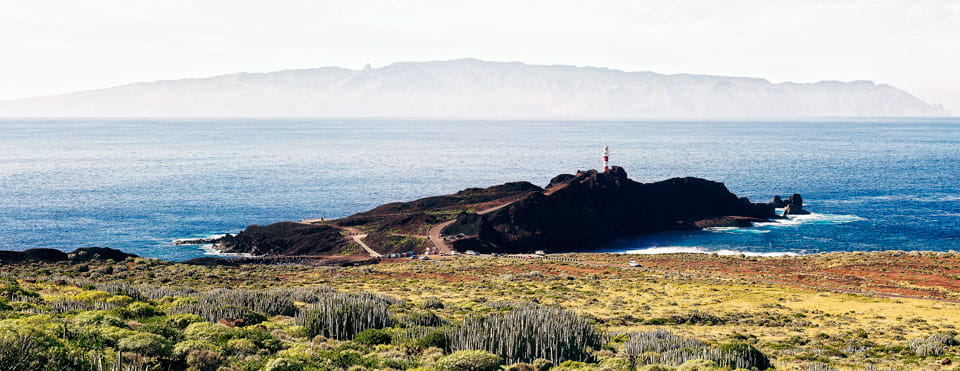
Teno Country Park
Teno Country Park is located in the north-west of the island of Tenerife and covers part of the municipalities of Buenavista del Norte, Los Silos, El Tanque and Santiago del Teide. Spanning 8,063.3 hectares (almost 200,000 acres), this is one of Tenerife's most beautiful nature areas and has preserved much of its ecological, scenic and cultural wealth, largely thanks to its isolated position. Once you set eyes on the area's complicated topography, you will find it incredible to think that people used to live there. The variety of its landscapes has it all, from magnificent cliffs, valleys, islands and laurel forests to wonderful pieces of traditional architecture.
How to get there:
By guagua (bus): From Buenavista or Santiago del Teide, line 355.
By car: From Buenavista along the TF-436 Buenavista-Santiago del Teide road, and along the TF-445 Buenavista-Faro/Punta de Teno road. From Armeñime along the TF-82 Icod de los Vinos-Armeñime road.
How to get to the lighthouse:
| Period | Days of the week | Opening hours |
|---|---|---|
| Summer (July, August & September) |
Tuesday to Thursday | 9:00 to 20:00 |
| Rest of the week | From 09:00 on Friday until 20:00 on Monday |
|
| Rest of the year (October to June) |
Tuesday to Thursday | 10:00 to 19:00 |
| Rest of the week | From 10:00 on Friday 19:00 on Monday |
- Emergency vehicles, people with reduced mobility, people transporting boats, public services and bicycles.
- Vehicles with authorisation (local property owners and workers, active tourism companies…).
- Public transport buses (line 369). There is now a new bus service at a reduced rate for easy access.
What to see:
The highlands, which are caressed by the trade winds (affording the Island its wonderful climate) are covered by an ecosystem known as the monteverde (macaronesian heathland and laurel forests). If you journey up to Monte del Agua, you will be walking amidst beeches, Canary Island laurel, small-leaved holly bushes and strawberry trees. This abundance of lush vegetation contrasts sharply with the south side of the Park, where the greenery is completely different, to the point that it feels like a whole new world despite being just a few hundred yards away. Here, the most significant plant species are broom bushes and euphorbia. On the north-facing slopes, the scenery changes once again to reveal stunning palms and magical dragon trees. On the Punta de Teno headland you will discover some of the largest and best-kept examples of euphorbia and Canary Island spurge plants on the Island, which stand out for their sheer abundance and the size of certain specimens. A good way of proving their size is to stand beside one and take a picture, which also makes a great souvenir.
But Teno is not just about its spectacular landscapes; it is also a treasure in terms of biological diversity. This is a key refuge for certain endangered species, such as the laurel pigeon, the spotted lizard, the crow, the Masca limonium, the amargosa and the corazoncillo de Masca, to name just a few. The presence of species such as the osprey (the rarest bird of prey on the Island) has led this to be declared a Special Bird Protection Area. Take your time to admire their majestic flight and honed hunting techniques – a true gift of nature.
Teno Country Park houses several village areas. The hamlets of El Palmar, Teno Alto, Las Lagunetas, Las Portelas, Los Carrizales, Masca and Erjos, for instance, rely largely on farming and livestock, mostly for their own consumption.
Around these hamlets you will find old ovens that were used for baking tiles or bread, as well as communal threshing floors and shelters that are typically used for livestock in farming areas such as Teno Alto.
The headland of Punta de Teno is the western-most point on the Island, surrounded by huge cliffs and a series of dikes and rocky peaks. Here, you will notice the striking contrast between the deep ravines that open out onto small beaches and the vast valleys that define the areas of Isla Baja and Teno Bajo. This natural area is home to significant biological diversity and shelters a number of endangered and native species.
For this natural space, at the end of the page you will find two audio guides (one for the outward journey, and the other for the return) in several languages, which you can download to your mobile device, with detailed, fascinating information about your excursion.
A small, well-preserved lighthouse stands on the edge. This is where you will get the best views of the dizzying cliffs of Los Gigantes that drop into the sea from heights of up to 600 m (1,970 ft). You might also witness a fairytale sunset that will captivate the hearts of the most romantic onlookers. If you would like to see some stunning landscapes from the mountains, visit the town of Masca, one of Tenerife's most singular corners.
What to do:
Getting here is an experience in itself as you will see spectacular scenery all along the way. Once you get here, you mustn't leave before you've gone hiking, kayaking, paddle surfing, diving or mountain biking.
There are over 100 kilometres of approved trails to take you deep into the heart of nature. Tenerife's deepest ravines can be found here, where the first inhabitants of Masca built their houses in-between towering rock walls. This picturesque spot houses one of the finest examples of traditional Canarian architecture. Up until just a few decades ago, it was almost entirely isolated from the rest of the Island due to communication difficulties, which means it is exceptionally well-preserved.
The Los Pedregales Visitor Centre focuses its work on studying, preserving and promoting the Park's assets and is definitely worth visiting. It welcomes tourists seeking individual information about the network of trails and other sites in the Park, and organises educational activities in schools, subject to availability and advance booking.
Los Pedregales Visitor Centre
Finca Los Pedregales s/n. El Palmar, 38480. Buenavista del Norte.
Tel. 0034 922447974
E-mail: tenoparque@tenerife.es
Opening hours: Monday to Sunday from 9.30 am to 16:30 pm.
Teno also has a lodge known as Albergue de Bolico where you can spend a few days in the peace and quiet of this wonderful part of the Island. It is equipped with everything you might need and also contains information about the nearby trails, local products and craftsmanship.
Albergue de Bolico
Finca de Bolico (in the area of Las Portelas). Buenavista del Norte.
Tel. 0034 922127334Website: Albergue de Bolico
And if you're hoping to get even more out of your stay in the area, treat your taste buds to a visit to the Farmers Market in El Palmar, where you will experience Teno's agricultural significance and wealth. This includes some of the Island's exclusive varieties of potatoes, unique cheeses, wines, local saffron, a wide variety of fruits and locally-sourced honey.
El Palmar Farmers Market
Finca Los Pedregales s/n. El Palmar, 38480. Buenavista del Norte.
Tel. 0034 922 44 79 74 / 70
E-mail: tenoparque@tenerife.es
Opening hours: Sundays from 9.30 am to 1.30 pm.
If you really want to get to know Teno Country Park, mingle with the locals and allow their hospitality to win you over. This is a great opportunity to sample the local produce by trying some of the area's rich dishes in one of its restaurants.
Depending on the time of year, Teno might surprise you with its amazing festivities. Celebrations linked to the end of the harvest season take place in September and October in the various hamlets. The festive events in El Palmar are particularly noteworthy because of their historic and cultural relevance, especially the dance known as Las Libreas, where three couples of dancers parade the streets under the watchful eye of the devil and the deviless to the sound of Tajaraste music.
What to take:
It is important to be well-prepared depending on the plans you have in mind (visiting hamlets and villages, touring by car, hiking, etc.). If you decide to head out on foot, we recommend you carry your mobile phone with you in case of an emergency, sun cream, a hat, a coat and a raincoat just in case the weather suddenly turns (which is often the case in this area), as well as water and food to keep you going and suitable footwear.
It is very important to plan the times of your outings to make sure you are back by 6 pm in winter and 8.30 pm in summer. Make sure you don't stray from the paths and trails or you could get lost.
If instead you decide to explore the coast, don't forget your swimsuit. If you have booked a tour that includes a boat trip, you might need sea sickness tablets.
Remember to take a small first aid kit with you containing the essentials for cleaning up wounds, tending to a bump or a sprain and easing the symptoms of indisposition. If you need any personal medication, don't forget to have it with you!
Check the weather forecast the day before you head out to make sure it will be good enough to be outdoors.
Let your friends or family know what you will be doing so somebody knows where to find you if anything happens.
Never go out hiking on your own.
We answer to your frequently asked questions
Everything you need to know about the Teno Rural Park
Where is Teno Rural Park?
Teno Rural Park is located at the north-western tip of Tenerife and is one of the island’s largest and best-preserved natural areas. Covering more than 8,000 hectares, it occupies part of the municipalities of Buenavista del Norte, Los Silos, El Tanque and Santiago del Teide. The park is formed by an ancient mountainous massif of volcanic origin, crossed by deep ravines, coastal cliffs, laurel forests and small traditional hamlets that have preserved much of their rural character. Its isolated location has helped protect both its landscapes and its traditions, making it one of the most authentic places in Tenerife. Within the park are well-known enclaves such as Masca, Teno Alto, Punta de Teno, El Palmar and Monte del Agua.
How do you get to Teno Rural Park?
You can access Teno Rural Park from different points of the island, although the most common routes start from Buenavista del Norte and Santiago del Teide.
- By car: the main access is via the TF-436 road, which connects Buenavista del Norte with Santiago del Teide, crossing some of the most spectacular landscapes of the Teno massif. It can also be reached from the south of Tenerife via the TF-82 towards Santiago del Teide.
- By guagua, or bus: TITSA route 355 connects Buenavista del Norte, Masca and Santiago del Teide, allowing access to several of the park’s main points of interest without the need for a private vehicle.
- On foot: many hikers access the park through the extensive network of trails that connects hamlets such as Masca, Teno Alto, Los Carrizales, Las Portelas and El Palmar.
The journey to the park is part of the experience, as it crosses deep ravines, natural viewpoints and some of the most impressive scenic roads in Tenerife.
Can you explore Teno Rural Park by bicycle?
Yes. Teno Rural Park is one of the most attractive natural areas in Tenerife for road cycling and mountain biking thanks to the variety of terrain and the spectacular nature of its landscapes. Among the most popular routes are:
- The TF-436 road between Santiago del Teide, Masca and Buenavista del Norte.
- The routes between El Palmar and Teno Alto.
- Various tracks and rural paths that cross the park’s mid-altitude areas.
- Routes that connect with Monte del Agua and other wooded areas.
- The steep slopes and constant changes in elevation mean that many of these routes are recommended for cyclists with some experience. In return, they offer panoramic views over ravines, cliffs, traditional hamlets and the Atlantic Ocean that are difficult to find elsewhere on the island.
In addition, cycling is one of the authorised ways to access Punta de Teno during periods when restrictions apply to private vehicle traffic.
Are there access restrictions in Teno Rural Park?
Access to Teno Rural Park is free on most of its roads, trails and hamlets, although some specific areas may have special regulations to protect the natural environment and ensure visitor safety. The best-known restriction affects Punta de Teno, where access by private vehicle is limited at certain times and during certain periods of the year. In those cases, access is possible by public transport, bicycle, authorised vehicles or designated services. There are also specific regulations in the Masca area. Access to the hamlet of Masca may be subject to traffic and mobility management measures, particularly due to the limited capacity of the road and car park. It is therefore recommended to use public transport or authorised services, and to check the current conditions before travelling. In addition, the Barranco de Masca trail is not freely accessible: to walk it, it is necessary to make a prior booking or request through the authorised official channels, respect the assigned date and time slot, comply with the established safety requirements, and bear in mind that access may be temporarily closed due to weather conditions, conservation work, maintenance or other causes. Before visiting the park, it is advisable to check the condition of the trails and any temporary restrictions at the Los Pedregales Visitor Centre or through the official channels of the Cabildo de Tenerife.
What is the Teno Rural Park Visitor Centre?
The Los Pedregales Visitor Centre is the main information point for Teno Rural Park and a highly recommended stop for those visiting the area for the first time. Its role is to help visitors better understand the park’s natural, cultural and ethnographic values, as well as to provide practical information for planning excursions and activities. At the centre, you can find:
- Up-to-date information on trails and access.
- Maps of the park’s trail network.
- Information on flora, fauna and endemic species.
- Recommendations according to the difficulty level of the routes.
- Information on educational and outreach activities.
It is located in El Palmar, Buenavista del Norte, and is open every day. It is also the best place to ask about the condition of the paths or the weather before starting a route.
What can you see in Teno Rural Park?
The variety of landscapes is one of the park’s great attractions and means that every visit can be different. Among the most notable places are:
- Masca, considered one of the most distinctive villages in Tenerife because of its location among mountains and ravines.
- Punta de Teno, where the lighthouse is located and where you can enjoy some of the best views of the Los Gigantes Cliffs.
- Teno Alto, one of the island’s most authentic rural areas, known for its livestock tradition and the production of artisan cheeses.
- Monte del Agua, one of the finest examples of laurel forest in the Canary Islands.
- El Palmar and Los Carrizales, small rural settlements surrounded by trails and agricultural landscapes.
In addition, along the way it is common to find natural viewpoints, old ovens, traditional threshing floors and constructions linked to agricultural and livestock activity.
What are the best hiking routes in Teno Rural Park?
The park has one of the most extensive trail networks in Tenerife, with more than 100 kilometres (62 miles) of approved paths connecting ravines, mountains and traditional hamlets. Some of the most popular routes are:
- Teno Alto – Punta de Teno, with impressive views over the cliffs and the western coast.
- Monte del Agua, ideal for exploring laurel forests and discovering the island’s more humid vegetation.
- El Palmar – Teno Alto, a traditional route highly appreciated by hikers and cyclists.
- Los Carrizales – Masca, which crosses some of the most spectacular areas of the massif.
- Masca Ravine, one of the best-known routes in Tenerife when it is open to the public.
The routes have different levels of difficulty, so it is advisable to seek information in advance at the Los Pedregales Visitor Centre.
What is the climate like in Teno Rural Park?
The climate in Teno Rural Park varies considerably depending on the altitude and the area you visit. This climatic diversity is one of the reasons why the park contains such different ecosystems within a relatively small area. The areas exposed to the trade winds, such as Monte del Agua and the laurel forest areas, are usually more humid, cooler and cloudier. By contrast, the southern slopes and the coast of Punta de Teno have a drier and sunnier climate for much of the year. It is common to find:
- Mild temperatures throughout the year.
- Fog or a sea of clouds in the higher areas.
- More humidity in the monteverde forests.
- Sunshine and clear skies in the coastal areas.
- Rapid weather changes between different parts of the park.
For this reason, even if you visit Teno Rural Park in summer, it is advisable to bring a light warm layer and check the weather forecast before going hiking or taking part in outdoor activities.
What flora and fauna can be seen in Teno Rural Park?
Biological richness is one of the park’s main values. Thanks to changes in altitude, orientation and climate, Teno is home to very different ecosystems within just a few kilometres (a few miles). Flora Depending on the area, you can see:
- Laurel forest and monteverde.
- Fayal-brezal woodland species such as fayas, acebiños and madroños.
- Canarian palms and dragon trees.
- Retamas, tabaibas and cardones.
- Numerous endemic species found only in Tenerife and the Canary Islands.
Among the most distinctive species are the Masca siempreviva, the amargosa and the Masca corazoncillo. Fauna The park is an important refuge for protected species such as:
- Laurel forest pigeons.
- The Tenerife speckled lizard.
- The Canarian raven.
- The osprey, one of the rarest birds of prey on the island.
Birdwatching is one of the most recommended activities for nature lovers.
Where to stay near Punta de Teno and Teno Rural Park?
Although accommodation within Teno Rural Park is limited in order to preserve the natural environment, there are many options in the nearby hamlets and municipalities for those who wish to spend several days exploring the area. Among the most common alternatives are:
- Rural houses in Teno Alto, El Palmar, Los Carrizales and other areas of the park, ideal for enjoying tranquillity, hiking and nature.
- Bolico Hostel, located in Las Portelas, a very popular option among hikers and groups wishing to explore the park’s trail network.
- Rural hotels and small family-run accommodation in Buenavista del Norte, with easy access to Punta de Teno and the Los Pedregales Visitor Centre.
- Holiday apartments in Buenavista del Norte, Los Silos and Santiago del Teide.
- Hotels and tourist complexes in Los Gigantes and Puerto de Santiago, for those who prefer to combine nature with tourist services.
Many travellers use this area as a base for spending several days exploring trails such as those in Teno Alto, Monte del Agua or Masca, enjoying the viewpoints and watching the spectacular sunsets at Punta de Teno.
Where to eat in Teno Rural Park?
Gastronomy is a fundamental part of the experience in Teno. The restaurants, bars and guachinches in the area maintain a strong connection with the traditional agriculture and livestock farming that is still preserved in many of its hamlets. The best areas to eat are:
- El Palmar, known for its traditional restaurants and its proximity to numerous trails.
- Teno Alto, where some establishments offer local products made by the area’s own livestock farmers.
- Buenavista del Norte, which has a wider and more varied gastronomic offering.
- Masca, with small restaurants and terraces surrounded by impressive mountain scenery.
- Santiago del Teide, ideal for those visiting Masca and the park at the same time.
Among the most representative products are:
- Artisan cheeses made in Teno Alto and other livestock-farming areas of the park.
- Local potatoes grown in the mid-altitude areas.
- Goat meat and traditional Canarian dishes.
- Local honey produced in the park’s hamlets.
- Tenerife wines.
- Fruit and locally grown agricultural products.
If you visit the area on a Sunday, it is especially worth going to the El Palmar Farmers’ Market, where local producers sell cheeses, wines, honey, saffron, fruit and other traditional products from Teno Rural Park.
What are the opening hours of Teno Rural Park?
Teno Rural Park is a natural area open all year round and does not have general opening or closing hours for access to its roads, hamlets, viewpoints or trails. However, some facilities and specific areas do have their own opening times, such as:
- The Los Pedregales Visitor Centre.
- Bolico Hostel.
- Access to Punta de Teno, which may be subject to time restrictions for private vehicles.
If you are planning a hiking route, it is recommended to plan the activity so that you finish before nightfall. As a guideline, it is advisable to finish excursions before 18:00 in winter and before 20:30 in summer. Before your visit, it is worth checking the condition of the trails and the weather, as some routes may be temporarily affected for safety or conservation reasons.
Do you have to pay an entrance fee to visit Teno Rural Park?
No. Visiting Teno Rural Park is free and there is no general entrance fee to access the park. Visitors can freely explore its roads, viewpoints, hamlets and much of the approved trail network, while always respecting the conservation rules of the natural area. However, some activities or specific areas may be subject to regulation or require advance booking. In addition, certain access points, such as Punta de Teno, have restrictions on private vehicle traffic at certain times in order to protect the environment and improve safety. Before following hiking routes or visiting specific areas of the park, it is advisable to check the latest information at the Los Pedregales Visitor Centre or through the official channels of the Cabildo de Tenerife.