
Anaga Country Park
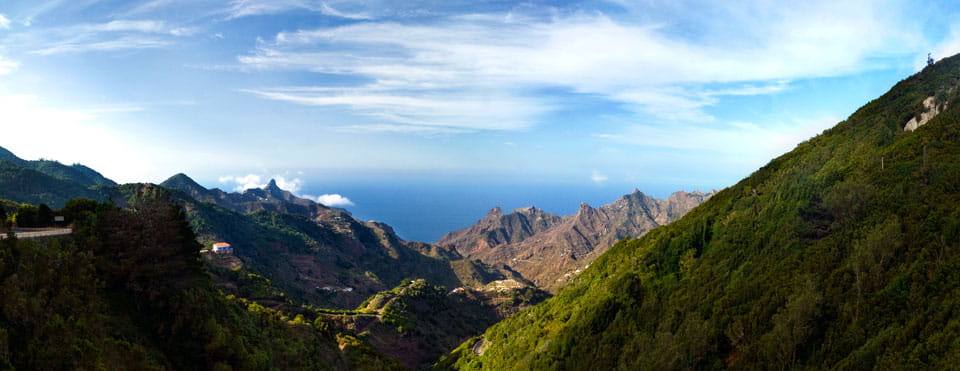
Anaga Country Park, which has been declared a Biosphere Reserve and has succeeded in preserving its natural assets quite exceptionally. You would not be the first person to be besotted by its beautiful precipitous mountain chain full of sharp peaks. The deep valleys and ravines that cut across it eventually reach the sea, forming a series of beaches where you can take a refreshing dip. The area is also home to a wealth of fauna and flora with plenty of native species.
Anaga Country Park covers much of the mountain range located on the north-west of the Island. With an expanse of almost 14,500 hectares (35,800 acres), it crosses quite a significant stretch of Tenerife, spanning the municipalities of La Laguna, Santa Cruz de Tenerife and Tegueste.
It represents one of the region's major leisure areas and is a great tourist attraction.
How to get there:
By guagua (bus): From Santa Cruz, lines 945 and 947. From La Laguna, lines 076, 077, 273, 274 and 275.
https://reservabiosfera.tenerife.es/descubre-anaga/transporte/
By car: From Santa Cruz take the TF-11 that links Santa Cruz with San Andrés, then the TF-12 to Igueste de San Andrés and El Bailadero. From there, take the TF-134 to Taganana, Almáciga, etc.
What to see:
The impressive sight of its robust mountains rising high above the nearby sea is as attractive as it is unique. But if you really want to make the most of your visit, the best idea is to follow one of the many trails that will lead you to its charming little beaches of fine, shiny black sand (such as Benijo) dotted along the coast. Whip off your shoes and stroll along the delicate volcanic sand beach, dive into the Atlantic waters and feel your senses burst uncontrollably.
The area's landscapes are also adorned with geological formations such as "roques" (old volcanic chimneys), dikes (fractures filled with solidified magma forming sheets of rock that look like walls), cliff faces and deep ravines. Another of the area's unforgettable sights is, without doubt, the blanket of clouds.
High up on the peaks you will find Tenerife's most wonderful areas of laurel forests. This vegetation could quite simply be classed as a living fossil, having survived more that 40 million years. The Mediterranean basin used to be covered in this greenery until the glaciers swept it away. A walk amongst this forest's twisted tree trunks lined with moss is like a journey back in time. Listen to the forest, feel it and breathe in its prehistoric air. As if all of this weren't enough, the Anaga mountain range is geologically one of Tenerife's oldest areas, which along with the varying altitudes, weather conditions and soils provide it with a huge biological diversity for such a relatively small space. Almost every kind of ecosystem on the Island can be found here, except high mountain flora and fauna. It contains coastal vegetation, populations of Canary Island spurges and euphorbia, dragon trees and Canarian palms.
And where the flora is rich and diverse, so too is the fauna. The undisputed kings are invertebrates. You will find almost a hundred species here that are unique in the world. If you are a keen birdwatcher, you might recognise such emblematic species as Scopoli's shearwaters, kestrels, owls, Bolle's pigeons and laurel pigeons (both of which are considered living relics and are native to the Canaries). In fact, the abundance of birdlife has led Anaga to become a Special Bird Protection Area. No less magnificent is the array of sealife, making quite a treat for divers, with such wonderful species as the chucho (a type of ray), the Canarian cod, the vieja and the endangered local eel.
The park also houses small settlements of people. You will find up to 26 small villages and hamlets inhabited by a total of 2000 people. Their residents live mostly off small-scale farming, tending traditional local crops such as sweet potatoes, potatoes, yams, vines and other fruit trees and plants.
What to do:
There are a whole host of options for you to experience the wonders of the Park: hiking, mountain biking, horse riding... If you are more of a sea lover, make the most of the area's good winds by going sailing, dive into the depths to explore the ocean floor, crown the Atlantic's powerful waves on a surf board, steer a kayak wherever you want, and why not try water skiing or wakeboarding?
Inside the Park there are several specially protected areas where access is restricted. If you would like to discover their carefully guarded secrets, check out the terms and conditions set by the Tenerife Government's Environmental Department. Call (+34) 922843097 or email coordinacionmam@tenerife.es
If you would like a convenient spot from which to access all of the Park's activities, a good option for accommodation is the Albergue de Anaga lodge. Located in the village of El Bailadero, the establishment is like a balcony overlooking both faces of the Anaga mountain range. It is just a short distance from the area's best beaches and is equipped with all the amenities.
Albergue de Anaga
El Bailadero-Chamorga road, 38129. Santa Cruz de Tenerife
Tel. 0034 922823225
Website: www.alberguestenerife.net
Prices: from €14.50
The Cruz del Carmen Visitors Centre is also worth visiting. It is dedicated to studying, preserving and promoting the Park, and organises special group tours.
Cruz del Carmen Visitors Centre
Las Mercedes road, Km 6, 38294. San Cristóbal de La Laguna
Tel. 0034 922633576
E-mail: cvisitantes@cabtfe.es
Opening hours: Monday to Sunday from 9.30 am to 4 pm.
What to take:
It all depends on the activities you plan on doing. If you decide to go for a hike, remember to take your mobile phone with you just in case you need it. Sun cream and a hat. A coat or jacket and a raincoat because the weather can turn quite quickly. Water and food to keep you going and, of course, suitable footwear as you might come across some rather rocky terrain. And don't forget your swimsuit in case your walk ends at one of the area's lovely beaches or bays. What could be better than a refreshing and replenishing dip in the sea?
Recommendations for responsible tourism
Explore the 10 principles of a shared commitment between the people who call Anaga home and those who visit it. Their purpose is to ensure that every visit helps preserve the unique character, natural beauty, and living heritage that make Anaga such a special place.
We answer to your frequently asked questions
Everything you need to know about the Anaga Rural Park
Where is the Anaga Rural Park?
The Anaga Rural Park is located in the north-east of Tenerife and covers a large mountainous area stretching between Santa Cruz de Tenerife, San Cristóbal de La Laguna and several small rural settlements on the Anaga coast, such as Taganana. It is one of the most singular natural spaces on the island, characterised by its rugged terrain, deep ravines, laurel forest and numerous scattered hamlets. Its proximity to the metropolitan area allows visitors to reach, in a short time, a very different environment where humid vegetation, traditional pathways and open views of the ocean predominate.
When was the Anaga Rural Park declared a protected area?
The Anaga Rural Park was declared a protected space in 1987, as part of the network of natural spaces of the Canary Islands. Its protection reflects the great ecological, landscape and cultural value of this mountain massif, considered one of the oldest territories in Tenerife and one of the finest examples of preserved laurel forest in the Canary Islands. Furthermore, in 2015 it was recognised as a UNESCO Biosphere Reserve, reinforcing its international importance as a space for conservation and balance between nature and human activity.
How to get to the Anaga Rural Park?
The most common way to reach the Anaga Rural Park is by car, using mountain roads such as the TF-12, which connects San Cristóbal de La Laguna with several access points to the park, viewpoints and rural settlements within the massif. From Santa Cruz de Tenerife the journey usually takes between 25 and 35 minutes, whilst from La Laguna it can be done in approximately 15–20 minutes, depending on the entry point. The route passes through areas of sharp bends and allows stops at very popular viewpoints such as Mirador Cruz del Carmen. It is also possible to reach the park by public transport using TITSA buses. The 947 line connects Santa Cruz with Taganana and several coastal settlements within the park, whilst the 076 line links La Laguna with Cruz del Carmen, one of the most common starting points for hiking trails. These lines provide access to specific areas of the park, although it is advisable to check timetables in advance as services are less frequent than in other parts of the island.
What is the best time of year to visit the Anaga Natural Park?
The Anaga Rural Park can be visited throughout the year, although many people consider the period between October and May to be particularly pleasant due to the mild temperatures and the greener appearance of the landscape. During the autumn, winter and spring months, temperatures in the higher areas of the park tend to range between 12 °C and 20 °C, which makes for comfortable walking and a very characteristic atmosphere in the laurel forest, where humidity and mist are a regular feature of the landscape. In summer, particularly between June and September, temperatures usually range between 20 °C and 28 °C, although in the elevated forested areas the conditions remain cooler than in other parts of Tenerife. On the Anaga coast, however, it can feel hotter and more exposed to the sun. In any season, it is advisable to check the weather before setting out, as conditions within Anaga can change rapidly between a high-altitude area, a ravine and the coast.
What is the climate like in the Anaga Rural Park?
The climate in the Anaga Rural Park can vary considerably over just a few kilometres due to the altitude, the mountainous terrain and the direct influence of the trade winds, which bring humidity to much of the massif. Mist, humidity and cooler temperatures are frequently encountered in the higher areas, particularly in the laurel forest zones near Mirador Cruz del Carmen, even when Santa Cruz de Tenerife is bathed in sunshine. This humidity is a permanent feature of the Anaga landscape and is one of the factors that sustains its vegetation. In the coastal areas, such as those near Taganana or Playa de Benijo, there tends to be more sunshine and mild temperatures for much of the year, although the weather can also change quickly depending on the time of day.
What clothing should I wear to visit Anaga?
When visiting the Anaga Rural Park, it is recommended to wear comfortable or walking shoes, carry water and bring clothing suited to rapid changes in weather, particularly if you plan to walk or explore several areas of the park. Even on sunny days, humidity, wind or mist are commonly encountered in the higher areas, especially near Mirador Cruz del Carmen and the laurel forest trails. It is therefore advisable to bring a light layer or a thin warm garment, even if it feels warmer on the coast. If you intend to walk, it is also recommended to bring sun protection, a cap or hat, and comfortable clothing that allows you to adapt to both humid zones and stretches more exposed to the sun, as the climate within Anaga can vary considerably over a short distance.
What are the opening hours for visiting the Anaga Rural Park?
The Anaga Rural Park is an open natural space, so there are no general access hours as would be the case with an enclosed site. It can be visited throughout the day, although it is most advisable to do so in daylight, particularly if you plan to walk trails or drive along mountain roads. Certain specific areas of the park, such as the Sendero de los Sentidos or particular routes with controlled access, may be subject to recommended visiting hours or specific conditions depending on the time of year. Furthermore, if you wish to visit the interpretation centre or go hiking, it is advisable to set off early in order to make the most of the day, avoid full car parks and enjoy better visibility at viewpoints and along trails.
How much does it cost to enter the Anaga Rural Park?
Visiting the Anaga Rural Park is free of charge and there is no general admission fee to access the park, drive along its scenic roads, stop at viewpoints or walk along the majority of its trails. This allows visitors to plan their visit freely, whether for a scenic drive, short walks or a visit to rural settlements such as Taganana, all within the same day. Only certain specific routes with capacity controls, particularly in environmentally sensitive areas, require advance booking in order to limit the number of visitors. In such cases, authorisation is required for conservation reasons, but does not entail any additional cost.
Where can I stay near the Anaga Rural Park?
Those wishing to visit the Anaga Rural Park often stay in nearby areas such as San Cristóbal de La Laguna or Santa Cruz de Tenerife, from where access to the park is quick and straightforward. There are also options in small rural settlements in the Anaga area, where rural cottages, accommodation with views of the mountain landscape and quieter propositions linked to the natural surroundings can be found. Staying nearby allows visitors to organise their visit at a leisurely pace, particularly if they wish to devote time to trails, viewpoints, the coast and local gastronomy all within the same day.
What can I see in Anaga Park?
The Anaga Rural Park brings together some of the most singular landscapes in Tenerife: mountains covered in laurel forest, deep ravines, viewpoints, small hamlets and traditional pathways that cross one of the oldest natural spaces on the island. Among the most visited spots are: Mirador Cruz del Carmen, one of the most well-known access points to the park and a popular spot for taking in the Anaga landscape and beginning easy routes.
- Bosque de los Enigmas (Forest of Enigmas), a laurel forest area particularly known for its humid atmosphere, dense vegetation and sense of enclosed woodland.
- Sendero de los Sentidos (Path of the Senses), a short and accessible trail ideal for a first encounter with the characteristic vegetation of Anaga.
- Taganana, a rural settlement surrounded by mountains where a strong traditional character is still preserved.
- The hamlet of Afur, frequently visited by those seeking rural landscapes and access to hiking trails.
- Coastal areas such as Playa de Benijo, well known for its sea views, volcanic landscape and the contrast between coast and mountain.
- Waterfalls and cascades such as Salto del Tornero, Barranco de Afur and Cascada de las Tres Cabezas, visible on certain routes and particularly after periods of rainfall.
The variety of landscapes allows visitors to combine viewpoints, hiking, brief stops in rural settlements and open views of the ocean all within a single day.
What hiking routes are there in the Anaga Rural Park?
The Anaga Rural Park has an extensive network of waymarked trails, with routes of varying difficulty and duration, ranging from short walks to more demanding routes through mountain terrain and ancient rural pathways. Among the best-known routes are:
- Sendero de los Sentidos, ideal for a first visit thanks to its short, accessible course, which is highly representative of the laurel forest.
- Routes from Mirador Cruz del Carmen towards Chinamada, where the trail passes through forested areas and offers open views over ravines and hamlets.
- Trails towards Taganana, highly regarded for combining mountain scenery with arrival at one of the best-known rural settlements in Anaga.
- Routes through the Bosque de los Enigmas, where the dense vegetation and humidity create one of the most characteristic atmospheres in the park.
- Paths around Cruz de Taborno, known for their sweeping panoramas and rugged terrain.
There are both short, accessible routes and more demanding ones, so it is advisable to choose according to experience, available time and weather conditions.
Do I need a permit to walk in Anaga?
For certain specific routes, a prior permit is indeed required, particularly in protected areas with controlled access such as the Bosque de los Enigmas, where visitor numbers are regulated in order to protect a particularly environmentally sensitive space. Many of the main trails, however, can be walked freely without advance booking, such as the Sendero de los Sentidos or several paths near Mirador Cruz del Carmen, which tend to be the most popular choices for a first visit. Before planning a route, it is advisable to check whether the chosen trail requires authorisation, especially during busier periods. This information can be found through the official channels of the Cabildo de Tenerife, such as the page https://www.tenerifeon.es/faq/actividades-en-la-naturaleza/permisos-para-los-senderos-de-anaga, or at the park's own information points, where any temporary restrictions due to conservation or safety reasons are also updated.
What types of routes can be done in Anaga besides hiking?
In addition to walking along its trails, the Anaga Rural Park can also be explored by car, bicycle or guided activities in rural settings.
- The driving route through Anaga is one of the most popular options and allows visitors to travel along the TF-12 road with stops at viewpoints such as Mirador Cruz del Carmen, pass through laurel forest zones and reach settlements such as Taganana or the coast at Playa de Benijo.
- Cycling routes from San Cristóbal de La Laguna towards the higher areas of Anaga are also available and are highly regarded by experienced cyclists due to the elevation and mountain bends.
- In certain rural areas, occasional activities such as horse riding can also be organised, usually through specialist companies and along authorised paths outside the park's most sensitive zones.
This makes it possible to adapt the visit to different paces and ways of discovering Anaga.
What can I do in the Anaga Rural Park?
A wide variety of activities can be combined in the Anaga Rural Park, so a visit is by no means limited to hiking. Many visitors enjoy stopping at viewpoints, taking in the landscape, photographing ravines and forests, visiting small villages and driving along scenic roads. It is also common to visit the Cruz del Carmen Interpretation Centre, where the geology, biodiversity and history of the massif are explained. In addition, there are coastal stops, short forest walks and the opportunity to experience the rural character of this part of north-eastern Tenerife.
How long does it take to visit the Anaga Rural Park?
The time needed to visit the Anaga Rural Park depends on the type of route chosen, but a typical visit usually takes between half a day and a full day. Those who follow a scenic driving route with viewpoint stops, a short walk and a visit to a rural settlement generally spend between 3 and 5 hours. If hiking, the coast or a lunch stop are added, it is common to set aside most of the day, as getting around within the park is slow due to the mountain roads and the frequent stops that the landscape naturally invites.
Where can I park in the Anaga Rural Park?
The most common parking areas in the Anaga Rural Park are found near Mirador Cruz del Carmen, at the access points to the main trails and in small settlements such as Taganana, where designated areas or limited roadside spaces are available. On busy days it is advisable to arrive early, as some areas have very few spaces available and the park's roads are narrow, with stretches where it is not always easy to pull over. Small lay-bys can also be found near viewpoints or trail access points, which are useful for brief stops. If you plan to visit several areas in a single day, it is generally recommended to plan your stops carefully, as parking can fill up quickly in some spots, particularly at weekends or on days with good weather conditions.
What beaches can I visit in the Anaga Rural Park?
Within the Anaga Rural Park area, some of the most distinctive beaches in north-eastern Tenerife can be found, highly valued for their natural landscape and the striking contrast between coast and mountain. Among the most visited are:
- Playa de Benijo, known for its sea stacks, dark sand and open ocean views, especially at sunset.
- Playa de Almáciga, situated in a small coastal area alongside traditional rural settlements and closely linked to the valley landscape.
- Playa de Taganana, close to the village and surrounded by an environment where the relationship between coast and mountain is clearly apparent.
These beaches retain a very natural character, with less development than other coastal areas of the island, and are therefore visited as much for their scenic value as for their open views of the ocean.
Is it advisable to visit the Anaga Rural Park with children?
Yes, visiting the Anaga Rural Park with children can be an excellent option, particularly if short routes and easily accessible areas are chosen. One of the most recommended spots is the Sendero de los Sentidos, as it offers a brief, waymarked and straightforward trail suitable for a first experience in nature without significant gradients. Viewpoints, rest areas and brief stops in hamlets such as Taganana also allow visitors to enjoy the landscape without the need for long or demanding routes. Furthermore, by combining forest, mountain and coast, Anaga offers sufficient variety to adapt the visit to the pace of each family.
Can I bring dogs into the Anaga Rural Park?
Yes, dogs are permitted in most areas of the Anaga Rural Park, although it is important to take certain precautions in order to protect the natural environment. It is recommended to keep them under control at all times, particularly on trails, in areas of sensitive vegetation or in places where protected wildlife may be present. Specific restrictions may apply on certain routes or in areas with regulated access. It is also important to respect signage at all times, collect waste and prevent animals from leaving the marked paths, as Anaga is home to particularly delicate ecosystems.
Where can I eat in the Anaga Rural Park?
In settlements such as Taganana and its surroundings, there are restaurants and small eateries where visitors can try local cuisine in a setting closely linked to the rural and coastal landscape of Anaga. Fresh fish, potatoes, traditional Canarian dishes and simple fare made with local produce are commonly found, particularly in areas close to the coast and in small family-run establishments. Many visitors take the opportunity to stop for a meal after a walk or after visiting several viewpoints, as in this area gastronomy is very much part of the experience and allows the day to be extended at a relaxed pace before continuing through the park.
What wildlife and flora can I observe in the Anaga Rural Park?
The Anaga Rural Park preserves one of the finest examples of laurel forest in the Canary Islands — an ancient type of humid woodland characterised by plant species adapted to constant mist and humidity. Among the most representative flora, laurels, fayas, heathers, hollies and large ferns can be observed, forming a very dense and distinctive landscape across much of the park. This vegetation is particularly visible on the mid-altitude trails and in the forested areas near Mirador Cruz del Carmen. In terms of wildlife, Anaga is an important area for birds such as blackbirds, endemic laurel forest pigeons and small woodland birds. Reptiles such as lizards and geckos can also be found, along with other species adapted to this singular ecosystem. The combination of geological isolation, humidity and relief has given rise to a very particular biodiversity within Tenerife.