Teide Fauna
Mount Teide National Park
As you creep quietly through the bushes you remember what it felt like to play explorers as a child. With your magnifying glass and binoculars in hand, you follow every insect or bird that crosses your path and eagerly pick up your book to see if you can identify the species and learn about its peculiarities and traits. You enjoy discovering animals you had never seen before, and Teide Natural Park is a great place for that with plenty of endemic species that you won't find anywhere else.
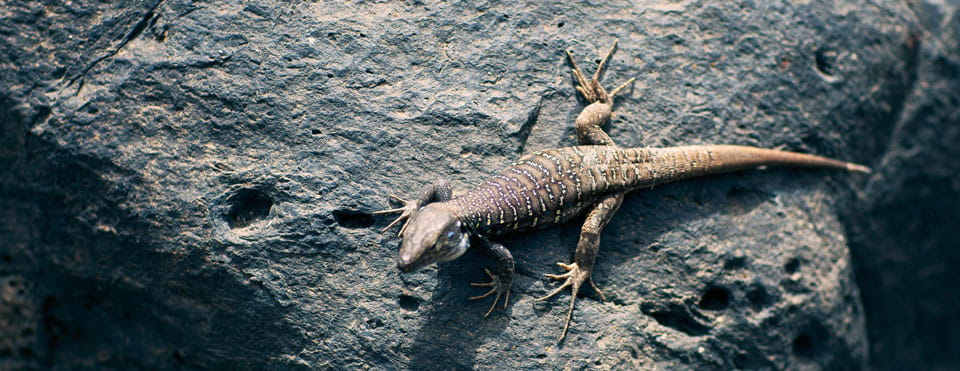
Covering an expanse of 20,000 hectares (49,500 acres), Teide National Park is a refuge for all sorts of interesting animals. Among the Park's vertebrate species are endemic reptiles such as lizards, geckos like the Tenerife Gecko, and the Gran Canaria skink, although the most emblematic reptile in this National Park is the Tenerife lizard (Gallotia galloti galloti).
The Park's bird-life comprises roughly two dozen species, only half of which regularly nest there. You are most likely to see Teide blue finches, Betherlot's pippits, wild canaries and kestrels, the most common bird of prey on the Island. Other more difficult to spot species living in the Park include the northern shrike (Lanius excubitor), the African blue tit (Parus caeruleus teneriffae) or the chiffchaff (Phylloscopus collybita).
Bats are the only native mammals in the Park, with five species. The most common is the lesser noctule (Nyctalus leisleri), while the endemic species is the Canary big-eared bat (Plecotus teneriffae). All three other species were introduced to the Park, as were the rest of the mammals that inhabit it, including mouflons, rabbits, feral cats, North African hedgehogs and Corsican mouflons.
But invertebrates are by far the most abundant creatures in Teide National Park, with over 1,400 species, over 40% of which are endemic. Spiders are particularly numerous, as are beetles and species of diptera, hemiptera and hymenoptera. In spring, the flowers attract a whole host of insects, especially thryps, cimex species, beetles, butterflies, wasps and many more. The blossom also attracts the honey bee (Apis mellifera), which allows bee-keepers to make top quality nectar.
In any case, whatever you come across, you have nothing to worry about as none of the fauna in this environment is harmful to humans.
The most significant species that can be found in Teide National Park are:
- Hedgehog (Aetechinus algirus)
- Tenerife lizard (Gallotia galloti galloti)
Animals
- Wild canary (Serinus canaria)
- Betherlot's pippit (Anthus b. Berthelotti)
- Chiffchaff (Phylloscopus Collybita canariensis)
- Plain swift (Apus u. Unicolor)
- Rock dove (Columba livia canariensis)
- Kestrel (Falco tinnunculus canariensis)
- Crow (Corvus corax tingitanus)
- Barbary partridge (Alectoris barbara)
- Teide finch (Fringilla t. Teydea)
Birds
We answer to your frequently asked questions
Everything you need to know about the wildlife of Mount Teide
What typical animals can be seen in Teide National Park?
Across its almost 20,000 hectares live endemic reptiles, birds and bats, the Park’s only native mammals. They are joined by a world of more than 1,400 species of invertebrates (spiders, beetles, butterflies), which make up the greatest species richness in the whole area. The Tenerife lizard (Gallotia galloti galloti) is the Park’s most emblematic animal and the easiest to spot basking in the sun among the rocks. Among the birds, the Tenerife blue chaffinch (Fringilla teydea) stands out, a species found only in Tenerife’s pine forests, along with Berthelot’s pipit and the Atlantic canary. And if you are patient at dusk, you may spot the Canary long-eared bat, a bat endemic to the islands.
What wildlife refuges can be found at Teide?
The National Park itself acts as a vast natural refuge: its altitude, extreme climate and isolation have allowed many species to adapt and survive here with hardly any predators or outside competition. The pine forests of the Corona Forestal, the rock outcrops and the scrubland of Las Cañadas are the places where wildlife most easily finds food and shelter.
What birdlife is there at Teide?
The Park is home to around twenty bird species, although only half of them regularly nest there. The most common are the Tenerife blue chaffinch, Berthelot’s pipit, the Atlantic canary and the common kestrel, the most widespread bird of prey on the island. With a little more luck and patience, you can also see the southern grey shrike, the African blue tit and the Canary Islands chiffchaff, which are more elusive species.
Are there mammals at Teide?
Yes, although they are scarce: bats are the Park’s only native mammals, with five species present, the Leisler’s bat being the most common and the Canary long-eared bat the only one endemic to the Canary Islands. The other mammals you may come across on the trails (the mouflon, the rabbit and the North African hedgehog, among others) were introduced by humans and are not native to this ecosystem.
Are there any dangerous species at Teide?
No, none of the wildlife species found in Teide National Park poses a danger to people, so you can explore its trails with peace of mind while watching lizards, birds or insects.
Which trails are best for observing Teide’s wildlife?
The Park has an extensive network of waymarked trails designed precisely to let you get close to these landscapes and their wildlife at a relaxed pace. Walking slowly and quietly, with binoculars to hand, through the pine forest and scrubland areas of Las Cañadas is usually the most effective way to come across lizards, birds and the insects that arrive in spring, drawn by the flowering plants.
What makes Teide’s wildlife different from that of other natural parks?
What sets Teide apart is its level of endemism: more than 40% of its invertebrates and a good number of its reptiles and birds exist nowhere else on the planet. The combination of altitude, island isolation and an extreme volcanic climate has forced these species to evolve in unique ways, giving rise to a high-mountain ecosystem very different from that of other protected areas.
Is Teide a good destination for wildlife watching and forest bathing?
Without a doubt. Birdwatching and mammal watching find an exceptional setting at Teide, thanks to its very high degree of endemism and the chance to spot species found nowhere else in the world, such as the Tenerife blue chaffinch, within a very small area. In addition, its pine forests and nearby laurel forests are perfect for forest bathing, an experience that combines unhurried contact with the local flora and fauna, enhanced by the tranquillity and pure air of a National Park declared a World Heritage Site.