
Carnival Groups & Contests
Every year, the carnivals bring a new opportunity for groups of friends to challenge one another. Contests between the various types of musical bands…
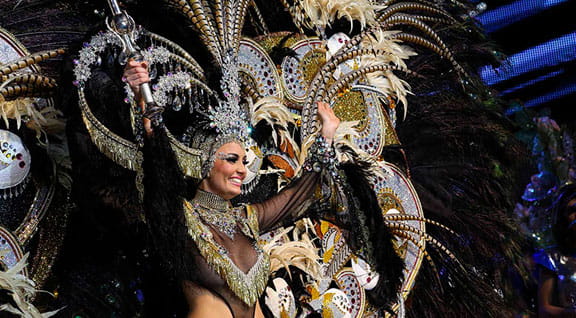
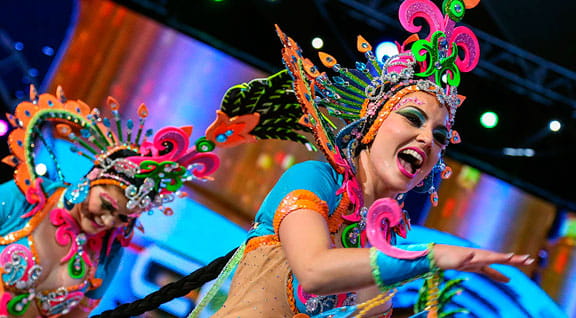
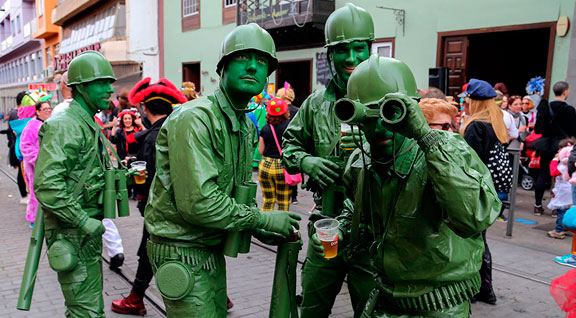
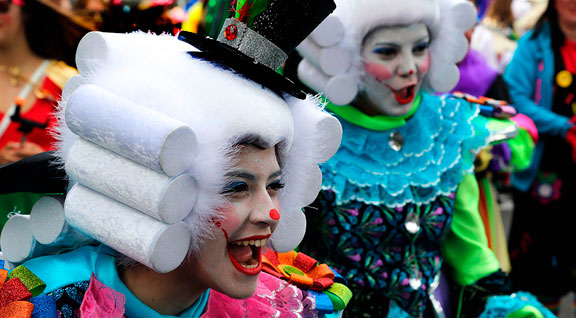
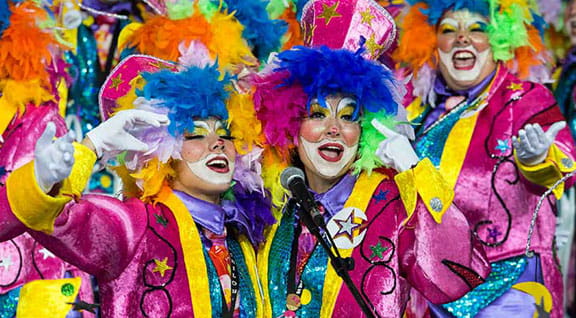
The Carnival of Santa Cruz de Tenerife takes to the streets from February 28 to March 9. Every day, the most emblematic corners of the capital of Tenerife are filled with onlookers who come to the multiple events. Citizens and visitors take out their costumes to enjoy the great atmosphere offered by Santa Cruz and its Street Carnival.
It begins on Friday, February 28, with the Cabalgata Anunciadora at 7:30 p.m., where also takes place the contest of floats and decorated cars. The Carnival Queen with her court, bands of street musicians, troupes, rondallas, groups and winners of the costume contest make up this fantastic parade. Starting from Plaza de la República Dominicana and ending at Avenida Francisco La Roche. At the end of this parade, the fun does not stop, giving start to the first night of celebration.
The first Saturday, March 1, the Children’s Carnival will be held from 5:30 p.m. to 9:00 p.m. at La Noria. In turn, the Rondallas Parade will make its way from Plaza Weyler to Plaza del Príncipe at 6:00 p.m. The Rhythm and Harmony Contest begins at 9:00 p.m. on Avenida Francisco la Roche, with the participation of all the troupes. This will be one of the great nights of celebration.
On Sunday, March 2, the first Day Carnival arrives. Plaza del Príncipe hosts the performances of Ni Fú-Ni Fá at 11:00 a.m. and Los Fregolinos at 12:00 p.m. The entire centre of Santa Cruz is filled with music, costumes and party.
The Dragnaval Gala is held on Monday, March 3, at 9:00 p.m. in Plaza de la Candelaria. Well into the night, the streets of the capital will attract a huge number of carnival-goers, it is the most crowded party of all.
The public holiday, March 4, begins with the performances of Ni Fú-Ni Fá at 11:00 a.m. and Los Fregolinos at 12:00 h. As a finishing touch, the Coso Apoteosis del Carnaval runs from 4:00 p.m. to midnight along Avenida Francisco la Roche. In this parade you can find all the greats characters of the carnival and the participants in the competitions of street musicians bands, Carnival Queen, troupes and costumes.
Ash Wednesday, March 5, is the Entierro de la Sardina (Burial of the Sardine), the favourite event of some. A parade made up of widows and mourners follows the float that transports the sardine amidst disconsolate cries and feigned fainting. It starts from Juan Pablo II Street at 9:00 p.m., ending at Plaza de España. Then comes the burning of the sardine on Avenida Marítima. The night ends with performances of great orchestras in Plaza del Príncipe from 11:30 p.m. to 3:00 a.m.
The event Sardina de la Inclusión (Inclusion Sardine) will take place on March 6 at 11:00 a.m. with departure in front of the Almeyda Barracks, ending in Plaza de la Candelaria, where there will be batukada and performances until 3:00 p.m. This is an event for everyone who wants to participate, adapted to accessibility to make it inclusive.
On Friday, March 7 at 6 p.m., the little ones enjoy Coso Infantil from the García Sanabria Park to La Marina. The stars of this parade are the children's Queen and her maids of honour, the prize-winners in the costume competition, bands of street musicians, troupes and children's choreographic groups. The children from the city's schools and children's centres prepare their costumes with great care for this occasion.
The second Day Carnival arrives on Saturday, March 8, many carnival-goers will tie this day with the last big night of celebration. They will flood the streets from pirates to pythonesses, through nurses and Romans, to the most original costumes you can imagine.
To end these days of celebration, glitter and fun, on March 9 there will be a multitude of events. Beginning in Plaza del Príncipe with the last performance of Ni Fú-Ni Fá at 11:00 a.m. and Agrupación Lírica La Zarzuela at 12:00 p.m. Also at this time, the Grand Competition of Antique Automobiles begins the tour through the streets of the city ending at Avenida Francisco La Roche where they will be exposed. The last stages of the carnival take place in Plaza de la Candelaria, with the Senior Carnival from 5:00 p.m. to 8:00 p.m., when the theme of the Carnival 2026 will be announced, followed by a dance with an orchestra. The carnival bids farewell until next year at 10:00 p.m. with a great pyrotechnic display.
The origins of the Carnival of Santa Cruz de Tenerife date back several centuries and are linked to the popular celebrations held before Lent. From its earliest days, the festival was characterised by dancing, masks, music and the custom of dressing up to take part in gatherings and festivities. Over time, the Carnival incorporated parades, competitions and musical groups, gradually developing the identity it retains today. This gave rise to such representative elements as the murgas, comparsas, rondallas, the election of the Carnival Queen, the Coso Apoteósico and the Burial of the Sardine. Even during periods when the celebration was restricted, local people maintained many of its customs under different names. This continuity helped establish the Carnival as one of the most important cultural and festive expressions in Santa Cruz de Tenerife.
The murgas are one of the most recognisable traditions of the Tenerife Carnival. Their songs combine music, humour and social criticism, often addressing current affairs and everyday situations with irony. The comparsas bring rhythm, dance and colour through choreography inspired by Latin music and striking costumes. The rondallas, meanwhile, represent a more lyrical and musical side of the Carnival, with carefully prepared performances and a style that differs from that of the groups taking part in the street festivities. Other highlights include the election of the Carnival Queen, the Opening Parade, the Coso Apoteósico and the Burial of the Sardine. These traditions are complemented by the spontaneous participation of the public, who take to the streets in costume, dance and gather around the stages set up in the city centre.
When people refer to the Tenerife Carnival, they usually mean the Carnival of Santa Cruz de Tenerife, held in the island’s capital. For several weeks, different venues throughout the city host galas, competitions, parades and musical performances. The exhibition centre hosts many of the galas and group competitions, while the main street events take place along the principal avenues, squares and central areas of Santa Cruz. Concerts, dances, parades and large public gatherings are held there. In addition to the Carnival in the capital, other municipalities in Tenerife organise their own celebrations. Places such as Puerto de la Cruz, Los Cristianos and Los Gigantes have their own programmes, characters and traditions, making it possible to experience different forms of Carnival during the same stay.
The Carnival of Santa Cruz de Tenerife stands out for the scale of its galas, the elaborate costumes worn by its queens, the murga competitions, the comparsas and an extensive programme combining indoor shows with large-scale street celebrations. One of its most distinctive features is the variety of groups that take part in competitions and parades over several weeks. The involvement of the public is also particularly notable, as people play an active part in the festivities by dressing up, dancing and joining both daytime and night-time celebrations. Other carnivals in the Canary Islands have their own traditions and distinct identities. Some are known for their themed galas, while others are recognised for particular characters, costumes or popular celebrations linked to local history. Each island offers a different experience, so combining several festivities can be a good way to discover the cultural diversity of the archipelago.
The dates of the Tenerife Carnival change every year because they are linked to the Easter calendar. The programme usually begins with competitions and galas and continues for several weeks, culminating in the main street Carnival events. The most popular part of the celebration includes parades, concerts, the Daytime Carnival, night-time parties and other large-scale events. Some activities take place during the week, while others are concentrated at weekends. To find out the exact dates of each edition, it is advisable to check the official programme before booking your trip. This will allow you to organise your accommodation, transport and activities around the events that interest you most.
The official programme for the Carnival of Santa Cruz de Tenerife includes the dates, times and locations of galas, competitions, parades, concerts and street activities. It also indicates which events require a ticket and which are held in open public spaces. It is worth checking the programme when planning your trip so that you can choose the most suitable days and confirm where each event will take place. Some events are held indoors, while others follow routes through different streets and avenues of the city. It is also advisable to consult the programme during the Carnival itself. Times, routes and venues may change for organisational, weather-related or safety reasons, particularly for events attracting the largest crowds.
The parades, the Daytime Carnival and many concerts and street activities are usually free of charge. However, some galas and competitions held in venues with limited capacity require a ticket. Ticket sales are announced each year through the official channels of the Carnival of Santa Cruz de Tenerife. Prices depend on the type of event, the location of the seat and the conditions established for each show. It is advisable to purchase tickets only through the official platform or authorised sales outlets. Some galas may sell out quickly, so it is worth checking the ticket release date in advance and avoiding unverified resale websites.
Yes. The Carnival of Santa Cruz de Tenerife includes a programme in which children also take part. Regular events include children’s murga competitions, the Children’s Carnival Queen Gala, parades and activities designed for families to enjoy together. Daytime events are generally the most convenient for families with children, as they make it possible to enjoy the atmosphere in a more relaxed setting. There are also events where children’s groups present their songs, choreography and costumes. When attending as a family, it is advisable to bring water, sun protection, comfortable clothing and a light outer layer. At particularly busy events, it is useful to identify the entrances, rest areas and a meeting point in advance in case anyone becomes separated from the group.
Wearing a costume is not compulsory, but it allows you to experience the Tenerife Carnival in a more enjoyable and participatory way. Many people choose full costumes, while others opt for simple accessories, make-up or themed clothing. The most important thing is for the costume to be comfortable and suitable for walking, dancing and spending several hours outdoors. Lightweight fabrics, closed footwear and accessories that do not restrict movement are recommended. It is also advisable to avoid items that are too bulky or delicate, particularly in the most crowded areas. For the Night-time Carnival, it may be useful to bring a warm layer that can be easily incorporated into the costume.
On the busiest days, public transport is usually one of the most practical ways to reach the centre of Santa Cruz. Interurban guaguas, or buses, connect the capital with different municipalities across Tenerife, and many routes terminate at the Santa Cruz transport interchange. From there, you can continue on foot or connect with other urban transport services, depending on the area where each event is being held. Using public transport also avoids the difficulty of finding parking and the traffic restrictions commonly introduced during the main parades. Transport operators usually provide additional services, night routes and timetable or route changes during the Carnival. Before travelling, check the special timetables and official notices, as some stops may be temporarily relocated because of road closures or Carnival routes.

