
Casa de los Balcones
Built in roughly 1670 with the help of some of the finest carpenters of that time, this house's most notable feature is its large Tea wood balcony on…
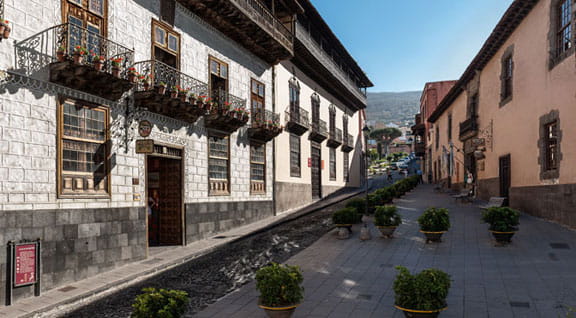
Many believe that La Orotava is one of the most beautiful areas in Tenerife. Located in the Valley of La Orotava, the town is made up of wonderfully kept traditional houses, leading the town centre to be declared a Historic-Artistic Site. The atmosphere is full of that stately air that settled after the conquest and has pervaded ever since.
Though located in northern Tenerife, this municipality also covers part of the middle of the Island, and its name comes from the Guanche word for the area: “Arautava” or “Arautapala”. This is the Island's largest municipality, spanning 207.31 km2 (80.04 sq miles), and has the vastest expanse of forest: Roughly 78% of Teide National Park belongs to La Orotava. The historic quarter stands at an altitude of 390 m (1,280 ft) and was declared a Historic-Artistic Site in 1976. Its streets are sprinkled with buildings full of heritage and some highly significant sights such as the European University of the Canary Islands. The Valley of La Orotava has always stood out for its stunning landscapes crowned by the peak of Mount Teide, and also for its abundance of water, magnificent gardens and pleasant climate. And on top of that, the valley comprises several protected nature areas, such as part of Teide National Park and of Corona Forestal Natural Park, the Pinoleris Nature Reserve and the Protected Landscape of La Resbala.
The typical balconies adorning the façades of its traditional houses are a well-known feature, as are the carpets made of flowers and volcanic sand that are laid every year on the streets of La Orotava during the Corpus Christi celebrations and the traditional Holy Week festivities that have been taking place here since the 17th century.
Routes around the municipality
The streets of La Orotava welcome visitors to stroll around the town and discover its historic and artistic secrets on a tour that is not to be missed. The historic quarter of this municipality is divided into Villa de Abajo, which once housed the more wealthy families, and Villa de Arriba, with more modest buildings which nonetheless prove to be of significant architectural interest. Both areas can be explored on a tour by starting at Calle San Francisco, opposite the Church of San Francisco and the Santísima Trinidad Hospital. These buildings both stand on the land that once housed the Monastery of San Lorenzo, though now only its portico and the figure of the saint remain. Walking on towards the streets of Calle Colegio and Carrera del Escultor Estévez, visitors will see a great many examples of stately architecture, with many homes bearing the coat of arms of the families who built them on the façade. Among them, special mention should be made of Casa de los Balcones, with a distinctly Canarian character, combining masonry and woodwork on the façade and with a beautiful inner patio. The route then goes on towards Plaza del Ayuntamiento, which is covered once a year with a carpet made of volcanic sand to celebrate the Corpus Christi, and then on to the gardens of Hijuela del Botánico, behind the town hall, which were used as a nursery supplying plants for the Botanical Gardens in Puerto de la Cruz. On the street of Calle de San Agustín, visitors can see the magnificent houses of Marquesado de la Quinta Roja and Casa Ascanio, which overlook Plaza de la Constitución. Opposite is the Church and Monastery of San Agustín dating from the 17th century. A short stroll will then lead you to the majestic Church of La Concepción, which was declared a Historic Monument in 1948. The dome and steeples at either side of the façade are part of La Orotava's skyline.
Trails in the municipality
There are various trails across the countryside in La Orotava for those who enjoy doing some exercise in the fresh air. The PR-TF 35 Mamio-Pinolere route is 13 km (8 miles) long and is recommended for intermediate level hikers. The trail begins at La Caldera and climbs up to La Choza Chimoche and Portillo del Topo. It then goes on to meet the Mamio track past La Casa del Agua and along the ravine of La Arena.
La Orotava is located in the north of Tenerife, within the well-known La Orotava Valley, between the municipalities of Puerto de la Cruz, Los Realejos and Santa Úrsula. The municipality extends from the Atlantic coast to the summits of Teide National Park, which allows it to encompass a wide variety of landscapes: volcanic beaches, agricultural areas, pine forests and high mountain terrain. Its historic centre is one of the best preserved in the Canary Islands, with stately homes, historic churches and cobbled streets that reflect the history of the municipality.
Getting to La Orotava is easy thanks to its proximity to Puerto de la Cruz and its good connection to the motorway in the north of Tenerife.
Once in the municipality, it is easy to get around to the historic centre, the midlands or the nearby natural areas.
Among the must-see places in La Orotava are:
The historic complex, its viewpoints and its natural surroundings make La Orotava one of the most interesting municipalities to visit in Tenerife.
Activities in La Orotava combine culture, nature and local gastronomy:
It is also a good starting point for exploring the north of Tenerife.
La Orotava offers calm and educational activities for family visits:
Its peaceful atmosphere and open spaces make it a pleasant destination for families.
La Orotava can be visited throughout the year thanks to the mild climate in the north of Tenerife.
In addition, during the Corpus Christi and San Isidro festivities, the municipality celebrates some of its best-known events.
The weather in La Orotava is usually mild throughout the year. As it is located on the northern slope of Tenerife, the municipality may have slightly more humidity and cloud cover than the south of the island. Average temperatures usually range between 18 °C and 24 °C, with moderate summers and mild winters, allowing outdoor activities to be enjoyed during much of the year.
In La Orotava, you can find numerous restaurants, bars and traditional guachinches. Guachinches in La Orotava are typical establishments where home-produced wine is served together with homemade dishes from Canarian cuisine, such as grilled meats, papas arrugadas or local cheeses. In addition, in the historic centre and nearby areas there are restaurants and terraces where you can enjoy Canarian cuisine and local products.
Although the urban centre is located inland in the valley, the municipality also has coastal areas. Among the best known is Los Patos Beach, a natural volcanic sand beach located in a protected setting with views over the north of Tenerife. It is a place appreciated by nature and coastal landscape lovers.
La Romería de San Isidro Labrador is usually held at the end of June and is one of the most important festivities in the municipality. During this celebration, locals and visitors take part in a traditional parade with typical costumes, decorated carts, folk music and tastings of local products. It forms part of the patron saint festivities and is one of the most representative events in La Orotava.
La Orotava’s historic centre is located at approximately 390 metres above sea level, in the midlands of the La Orotava Valley.