
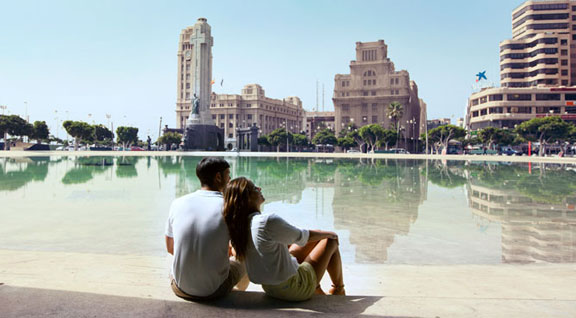
Santa Cruz de Tenerife
The Island's capital is a cosmopolitan and fascinating city. With places such as the García Sanabria Park, emblematic buildings like the Tenerife Adán Martín Auditorium or the Tenerife Arts Venue, the city is full of sights and even the simplest things seem magical here. A dose of retail therapy on its buzzing shopping streets followed by a leisurely drink on a sun-bathed terrace is a perfect example of these simple pleasures.
Santa Cruz de Tenerife has been the capital of the Island since 1833 and shares its function as the capital of the Autonomous Community of the Canary Islands with Las Palmas de Gran Canaria. It lies in the north-east of the Island and borders San Cristóbal de La Laguna and El Rosario, covering 150.56 km2 (58.13 sq miles). The highest point in the municipality is Cruz de Taborno, standing at an altitude of 1,020 m (3,346 ft). It has 58 km (36 miles) of coastline which is divided by the natural barrier of the Santos ravine. Santa Cruz and La Laguna together comprise the metropolitan area. The port is a key point in maritime communications between Europe, Africa and America, and is also well linked to the western part of the Canary Islands, welcoming trade ships and tourist boats.
Santa Cruz is a lively and bright city. Its best-known celebration is Carnival, to the point of being declared a Festivity of International Tourist Interest. Its streets welcome visitors to spend time out of doors and take walks through the park thanks to a lovely average annual temperature of 21.2 ºC (70.1 ºF). The city centre has a number of pedestrianised streets that are always bustling with life, making them great for all kinds of shopping. Its most emblematic historical buildings stand side-by-side with contemporary architectural masterpieces. There are also a variety of museums and art galleries, but the biggest exhibition is on display outdoors: Some of its avenues and parks feature works by Henry Moore, Martín Chirino, Joan Miró and Óscar Domínguez, as well as other artists. The most popular bathing areas are a little way out of the city on the remote beaches of Taganana and Benijos, but there are plenty more beaches such as Las Teresitas, which is adorned with palm trees and located next to the fishing district of San Andrés. The César Manrique Maritime Park is a lovely lagoon-like swimming pool complex in an up-and-coming area of the city.
Approved trails in the municipality
Santa Cruz de Tenerife lies near the Anaga mountain range, a humid forest area of great natural and geographical significance. The municipality therefore has a number of approved trails in Anaga Country Park, such as the PR-TF 2 linking the hamlet of Taborno to the district of Valleseco, on the city's coast. This trail leads hikers through various ecosystems with vegetation such as Macronesian heath and tree heath, as well as several old hamlets. This is an intermediate trail where it is advisable to wear reflective clothing as part of the trail is by the roadside. The downhill walk of PR-TF 5 Chamorga - Igueste de San Andrés is suitable only for more experienced hikers: The route starts at La Cumbrilla and El Lomo de las Bodegas, where it heads downwards to Igueste de San Andrés over a series of steep hills and uneven terrain. There is also the circular PR-TF 6 trail that journeys across Las Palmas de Anaga and El Draguillo. The PR-TF 8 is another circular trail that takes 7 hours and is intermediate in difficulty, passing Afur, Taganana and the Tamadite ravine.
Routes around the municipality
Strolling through the city centre of Santa Cruz, visitors will come across the traditional street of Calle de La Noria, with its wide array of restaurants and bars, the shopping areas all around Calle del Castillo, and pretty gardens decorating the squares and parks. But one of the things that most takes tourists by surprise is the amount of sculptures by international artists adorning the avenues of Santa Cruz de Tenerife. There is a walking route to explore them all starting at Rambla de Santa Cruz, a boulevard that crosses the city and is full of thriving Indian laurels. At the point where it crosses Avenida Reyes Católicos you will see “Móvil”, a spectacular work of art by Francisco Sobrino, standing near to the bronze statue of “Femme Bouteille” by Joan Miró. Walking on along the boulevard you will come to the “Guerrero Goslar” by Henry Moore, “Ejecutores y ejecutados” by Xavier Corberó, “Nivel” by Joaquín Rubio, and more. Near to this last figure is the García Sanabria Park, which also houses a series of works from the 1st International Street Sculpture Exhibition. After a slight detour through the park, visitors can return to the boulevard to see the striking work of Jaumé Plensa called “Islas” which shows a series of artists' names hanging from trees, and “Lady Tenerife” by Martín Chirino.Approved trails in the municipality
Santa Cruz de Tenerife lies near the Anaga mountain range, a humid forest area of great natural and geographical significance. The municipality therefore has a number of approved trails in Anaga Country Park, such as the PR-TF 2 linking the hamlet of Taborno to the district of Valleseco, on the city's coast. This trail leads hikers through various ecosystems with vegetation such as Macronesian heath and tree heath, as well as several old hamlets. This is an intermediate trail where it is advisable to wear reflective clothing as part of the trail is by the roadside. The downhill walk of PR-TF 5 Chamorga - Igueste de San Andrés is suitable only for more experienced hikers: The route starts at La Cumbrilla and El Lomo de las Bodegas, where it heads downwards to Igueste de San Andrés over a series of steep hills and uneven terrain. There is also the circular PR-TF 6 trail that journeys across Las Palmas de Anaga and El Draguillo. The PR-TF 8 is another circular trail that takes 7 hours and is intermediate in difficulty, passing Afur, Taganana and the Tamadite ravine.
We answer to your frequently asked questions
Everything you need to know about Santa Cruz de Tenerife
Where is Santa Cruz de Tenerife?
Santa Cruz de Tenerife is the capital of the island of Tenerife and shares the capital status of the Autonomous Community of the Canary Islands with Las Palmas de Gran Canaria. It is located in the northeast of the island, bordering San Cristóbal de La Laguna and El Rosario, and covers an area of 150.56 km². Together with La Laguna, it forms the most important metropolitan area in Tenerife.
Which festivals are celebrated in Santa Cruz de Tenerife?
In addition to the world-famous Carnival, Santa Cruz de Tenerife celebrates a variety of festivals and events throughout the year. Among the most important celebrations are:
- Santa Cruz de Tenerife Carnival, the city’s major festive event (February–March), declared an International Tourist Interest Festival.
- May Festivities, in honour of the Virgin of Consolation, with religious events, concerts and street entertainment.
- Canary Islands International Music Festival, held between January and February, featuring performances by internationally renowned orchestras and soloists at the Auditorio de Tenerife.
- Pilgrimages and neighbourhood festivals, which keep popular traditions alive throughout the year in different districts of the city.
How to get to Santa Cruz de Tenerife?
Getting to Santa Cruz de Tenerife is easy from any point on the island. By car: the capital is well connected through the TF-1 and TF-5 motorways, which link the north and south of Tenerife:
- From the south of the island: towns such as Los Cristianos or Costa Adeje are about 45–60 minutes away.
- From Puerto de la Cruz: the journey usually takes between 30 and 40 minutes.
From the airport:
- Tenerife North Airport (Los Rodeos): it is about 15–20 minutes by car, very close to the capital.
- Tenerife South Airport (Reina Sofía): the journey to Santa Cruz takes approximately 50–60 minutes.
By public transport, the municipality has an extensive network of interurban guaguas (buses) operated by TITSA, connecting Santa Cruz with all municipalities on the island. In addition, the tram links the capital with San Cristóbal de La Laguna quickly and comfortably. By sea, the port of Santa Cruz receives ferries connecting with the eastern Canary Islands, as well as cruise ships arriving from Europe, Africa and America.
What to see in Santa Cruz de Tenerife?
Santa Cruz de Tenerife combines historical heritage, contemporary architecture and natural spaces, making it a very complete city to visit. Among the most outstanding places are:
- Auditorio de Tenerife Adán Martín, an iconic work by architect Santiago Calatrava, recognisable for its striking sculptural shape facing the sea.
- Iglesia Matriz de la Concepción, the city’s main Catholic church, built on the site of the first hermitage founded on the island.
- Castillo de San Cristóbal, the first major fortification in Tenerife, with an underground interpretation centre in Plaza de España.
- Castillo de San Juan Bautista, popularly known as Castillo Negro, built in the first half of the 17th century.
- Parque García Sanabria, one of the most beautiful urban parks in the Canary Islands, with outdoor sculptures.
- Tenerife Espacio de las Artes (TEA), a modern cultural centre dedicated to contemporary art and cinema.
- Mercado de Nuestra Señora de África, the capital’s main market, with a wide range of fresh and local products.
- Palmetum Botanical Garden, a unique project that transformed a former landfill into a palm collection from around the world.
- Rambla de Santa Cruz, the city’s most emblematic urban promenade, lined with Indian laurels and sculptures by international artists such as Henry Moore, Joan Miró and Martín Chirino.
Discover more places to visit in the “Places of Interest” section.
What to do in Santa Cruz de Tenerife?
The capital of Tenerife offers a wide variety of activities for all tastes.
- Walk through the pedestrian streets in the city centre, especially Calle del Castillo, Rambla de Santa Cruz and surrounding areas, ideal for shopping and discovering outdoor sculptures by internationally renowned artists.
- Visit Mercado de Nuestra Señora de África and enjoy fresh produce, cheeses, tropical fruits and local crafts.
- Enjoy Parque Marítimo César Manrique, a seaside pool complex designed by the artist from Lanzarote.
- Go hiking in the Anaga massif, accessible from the municipality itself, via approved trails such as PR-TF 2, PR-TF 5 or PR-TF 8.
- Explore the fishing district of San Andrés and Las Teresitas Beach, just a few minutes from the centre.
- Experience the Santa Cruz Carnival, declared an International Tourist Interest Festival and one of the most famous in the world.
- Enjoy local gastronomy on terraces in the city centre or in restaurants in the La Noria district.
Which beaches are in Santa Cruz de Tenerife?
Although Santa Cruz is mainly an urban and commercial city, it has one of the most distinctive beaches on the island. Las Teresitas Beach is the most famous and emblematic beach on the island and is located next to the fishing district of San Andrés. It is a golden sand beach, protected by a breakwater and surrounded by palm trees.
What is the weather and temperature like in Santa Cruz de Tenerife?
The climate in Santa Cruz de Tenerife is warm and pleasant throughout the year, with an average annual temperature of 21.2 ºC. Summers are sunny and hot, with temperatures that can exceed 30 ºC, while winters are mild, with minimum temperatures rarely falling below 15 ºC. The city enjoys many hours of sunshine each year and very little rainfall, making it an ideal destination to visit at any time. The contrast between the north and south of the island is also noticeable in the capital: Santa Cruz, facing northeast, may receive slightly more cloud cover and cooler weather in winter than municipalities in the south, although good weather predominates throughout the year.
Which museums and cultural spaces are there in Santa Cruz de Tenerife?
Santa Cruz de Tenerife has a varied and high-quality cultural offer. Among the main museums and cultural spaces in the capital are:
- Tenerife Espacio de las Artes (TEA), dedicated to contemporary art, with an important collection related to Óscar Domínguez.
- MUNA, Museum of Nature and Archaeology, housed in a historic building and featuring an extensive collection of Guanche archaeology and natural sciences.
- Interpretation Centre of Castillo de San Cristóbal, located beneath Plaza de España, allowing visitors to discover the remains of the island’s first major fortress.
- Auditorio de Tenerife Adán Martín, home of the Tenerife Symphony Orchestra and venue for the island’s main concerts and performances.
- Rambla de Santa Cruz, considered the city’s largest open-air art gallery, with works by internationally recognised artists.
Where to eat in Santa Cruz de Tenerife?
Santa Cruz de Tenerife offers a wide gastronomic range, from traditional Canarian cuisine restaurants to more cosmopolitan proposals. Among the most common local dishes are:
- Papas arrugadas with red or green mojo
- Fresh Atlantic fish and seafood
- Grilled meats and traditional Canarian stews
- Desserts such as bienmesabe or frangollo
The La Noria district concentrates one of the liveliest dining areas in the city centre, with terraces and a wide variety of options. Mercado de Nuestra Señora de África is also an ideal place to try fresh local products and enjoy an authentic atmosphere.
Which festivals are celebrated in Santa Cruz de Tenerife?
In addition to the world-famous Carnival, Santa Cruz de Tenerife celebrates a variety of festivals and events throughout the year. Among the most important celebrations are:
- Santa Cruz de Tenerife Carnival, the city’s major festive event (February–March), declared an International Tourist Interest Festival.
- May Festivities, in honour of the Virgin of Consolation, with religious events, concerts and street entertainment.
- Canary Islands International Music Festival, held between January and February, featuring performances by internationally renowned orchestras and soloists at the Auditorio de Tenerife.
- Pilgrimages and neighbourhood festivals, which keep popular traditions alive throughout the year in different districts of the city.