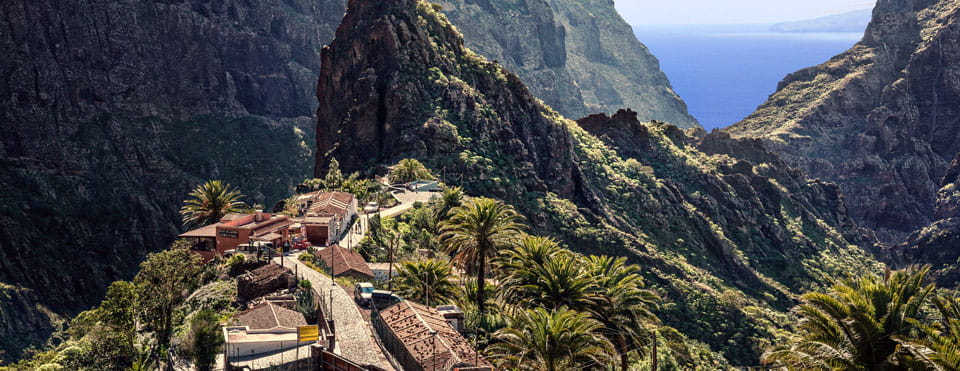
Village of Masca
In order to enjoy this natural space, you should be aware that there are a number of conditions and restrictions. Read the regulations here.
Municipality: Buenavista
The cottages in the hamlet of Masca are all lined up along the mountain ridges. They take up almost every inch of inhabitable space, balancing on the edge of the abyss created by the Island's deepest ravines. The Cherfe lookout point (on the road from Santiago del Teide) provides fantastic views over the hamlet.
This has always been a narrow and remote place, which was only very recently supplied with electricity, and where the roads were barely more than dusty tracks up until not long ago. In fact, for years the only means of communication with the rest of the world was the trail of Camino de los Guanches, linking Masca to Santiago del Teide. But that remoteness is precisely what has allowed it to keep its ancient charm.
Despite its small size, the area boasts a collection of valuable treasures such as the house of Los Avinculados in the hamlet of Piedra, and a tiny 18th century church. It even has a museum and a craft centre that have been set up inside one of the houses.
The hamlet is one of Teno Country Park's most charming attractions as it comprises all of the elements that make traditional Canarian architecture so unmistakable: masonry and wood, conceptual simplicity and full adaptation to surroundings.
A rock formation that was once used as an aboriginal sanctuary not far from the hamlet revealed an archaeological site featuring cave art. Legend has it that as a remote and solitary place, this was a favourite hideout among the pirates who roamed the Island.
The hamlet of Masca is an Asset of Cultural Interest and is classed as a Historic Site. Your visit here can be extended to explore other hamlets in the area as well as Masca, such as El Palmar, Las Portelas and Teno Alto.
We answer to your frequently asked questions
Everything you need to know about Masca
Where is Masca?
Masca is a small hamlet located in the north-west of Tenerife, within the municipality of Buenavista del Norte and in the heart of the Teno Rural Park. The hamlet is nestled in a spectacular valley surrounded by deep ravines and steep mountains, at around 650 metres above sea level, making the Masca valley one of the most recognisable landscapes in Tenerife. Its isolated location, between volcanic ridges and traditional agricultural terraces, has helped preserve the unique character of the hamlet of Masca, considered one of the island’s most emblematic rural settlements.
What is the history and origin of the hamlet of Masca?
The history of Masca is closely linked to the geographical isolation that shaped this area of north-west Tenerife for centuries. The difficult access to the valley encouraged the hamlet to develop a rural way of life strongly connected to mountain farming, with terraced crops, water management and architecture adapted to the slope of the land. The origins of the hamlet of Masca date back to ancient rural settlements established in a protected enclave between ravines and volcanic ridges, where a subsistence economy was maintained for generations. Today, the history of the hamlet of Masca remains one of the best examples of the preservation of Tenerife’s ethnographic heritage, both in its layout and in the agricultural landscape that still surrounds it.
How to get to the hamlet of Masca?
There are several ways to reach Masca, although the most common option remains road access through the interior of north-west Tenerife:
- By car: The main access route is via the TF-436 road, popularly known as the Masca road, a mountain road with numerous bends connecting the hamlet with Santiago del Teide and Buenavista del Norte. From Costa Adeje, the journey takes approximately 45 minutes; from Puerto de la Cruz, around one hour; and from Tenerife South Airport, close to one hour. The road passes through mountainous landscapes and well-known natural viewpoints, although it is advisable to drive carefully due to the narrowness of some sections and the sharp bends.
- By bus (guagua): TITSA operates line 355, which connects Buenavista del Norte, Masca and Santiago del Teide, making it one of the most commonly used options for visitors wishing to explore the hamlet or access the gorge trail without using a private car. Service frequency may vary depending on the day and season, so it is recommended to check the official timetables in advance.
- On foot: Masca also forms part of several hiking routes within the Teno Rural Park. Many hikers arrive on foot from nearby areas such as Santiago del Teide, Teno Alto or the traditional paths of the Teno massif, enjoying along the way some of Tenerife’s most spectacular rural and volcanic landscapes.
What to see and do in Masca?
Masca brings together some of the most impressive landscapes in Tenerife and several highly visited points of interest: – The hamlet of Masca, one of the island’s most emblematic rural settlements, preserves traditional stone houses and roofs adapted to the slope of the terrain, reflecting the popular mountain architecture that characterised this isolated area of north-west Tenerife for centuries. – The Mirador de Masca offers one of the most recognisable panoramic views of the Masca valley, with views over the ravine, the volcanic ridges surrounding the hamlet and, on clear days, the island’s western coastline. – The small church of the hamlet, integrated into the traditional settlement, provides one of the village’s most distinctive heritage elements and retains the simple character typical of Tenerife’s small rural communities. – The old agricultural terraces surrounding the village show how its inhabitants adapted the mountainous terrain for cultivation, creating stone terraces that still form an essential part of the valley’s landscape. – Access to the famous Masca Gorge, a deep volcanic ravine descending from the hamlet to the coast, crossing towering rock walls before reaching Masca Beach Tenerife. In addition, other enclaves within the Teno Rural Park can be visited near Masca, including natural viewpoints, scenic roads and privileged views towards the cliffs of north-west Tenerife, making the visit one of the most complete excursions in the island’s interior.
What trekking activities are available near Masca and which are suitable for beginners?
The surroundings of Masca offer several trekking options within the Teno Rural Park, with routes that allow visitors to discover ravines, viewpoints and ancient rural paths adapted to different levels of difficulty. The best-known walk is the descent through Masca Gorge, although this route requires good physical condition, prior booking and appropriate equipment. For those looking for easier options, a beginner-friendly alternative is to follow the short trails that start from the hamlet itself and connect with natural viewpoints overlooking the valley, offering panoramic views of the volcanic landscape without major elevation changes. Short sections of routes towards the outskirts of the hamlet or traditional paths leading to higher areas of Teno are also recommended, ideal for a peaceful excursion and for enjoying the scenery without undertaking demanding routes.
Where is Masca Beach and how do you get there?
Masca Beach Tenerife is a small pebble cove located at the end of Masca Gorge, surrounded by large volcanic cliffs and very close to the cliffs of north-west Tenerife. Its isolated and rugged setting makes it one of the island’s most unique coastal landscapes. Access to the beach is only possible on foot via the authorised gorge trail or by authorised boats from the nearby coast. It is not a beach with direct road access, but rather a natural enclave linked to the full experience of descending the gorge, so it is advisable to plan the visit in advance and always check access conditions.
Where to eat in Masca?
In the hamlet of Masca and its surroundings there are small restaurants and eateries serving traditional Canarian cuisine, closely linked to visitors exploring this inland area of Tenerife. The gastronomic offering usually focuses on simple recipes made with local produce, in a setting where the landscape forms part of the experience. It is possible to find restaurants in Masca Tenerife serving typical dishes such as meats, papas arrugadas, local cheeses, almogrote, stews and Canarian wines, often served on terraces overlooking the valley. Some small establishments also retain the atmosphere of traditional guachinches, especially in areas close to the road access, where homemade cuisine remains one of the main attractions of the visit.
What is the weather like in Masca and what is the usual temperature?
The climate in Masca is mild throughout much of the year, although being located in a mountainous area of north-west Tenerife means temperatures are usually somewhat cooler than on the coast and can vary quickly depending on the time of day. Mild days predominate, with usual temperatures between 16 and 24 °C, making the hamlet pleasant for walking almost all year round. The altitude, the orientation of the valley and the proximity to mountainous terrain favour rapid changes in cloud cover, especially in winter or during the early hours of the morning, when the atmosphere is usually more humid than on the nearby coast.
What festivals are celebrated in Masca?
The hamlet maintains small religious celebrations and neighbourhood gatherings linked to the rural traditions of this part of the Teno Rural Park, where a strong community identity still survives. These festivities preserve the close-knit atmosphere typical of Tenerife’s small historic settlements, with simple events connected to local life, religious celebrations and neighbourhood gatherings around the hamlet. Although smaller in scale than those of other municipalities, they continue to form part of Masca’s cultural life and its connection with the traditional customs of the area.
Where to stay in Masca?
Masca offers small rural accommodations and traditional houses adapted for tourism, highly sought after by those wishing to spend a night in one of Tenerife’s most unique landscapes. Accommodation in Masca Tenerife is generally focused on rural tourism, with small establishments integrated into the landscape and overlooking either the valley or the mountainous surroundings of the Teno Rural Park. Many of these houses preserve elements of traditional architecture, allowing visitors to enjoy an experience more closely connected to the historic character of the hamlet.
Is it possible to park in the hamlet of Masca?
Parking in the hamlet of Masca is limited due to the layout of the settlement itself and the narrowness of the TF-436 road, which restricts access and the number of available spaces. During peak hours it is advisable to arrive early, especially if visiting the gorge or the Masca Gorge Trail Visitor Centre, as spaces are limited and access control may vary depending on the season and visitor numbers. At certain times of the day, higher occupancy is common, particularly at weekends and during holiday periods.