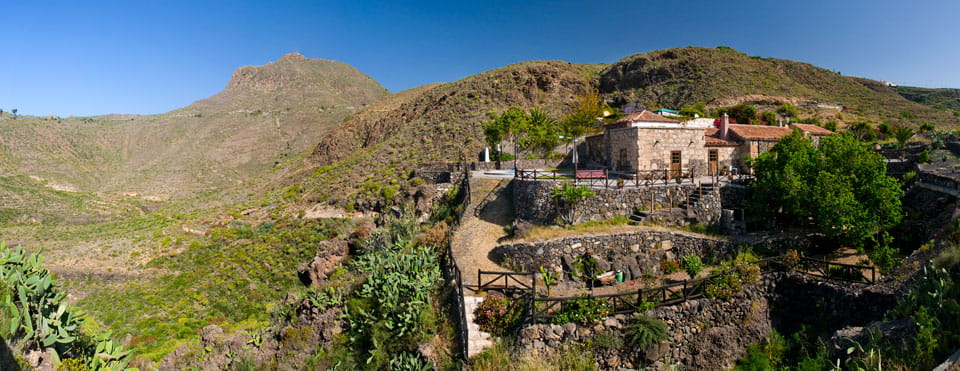
La Hoya
Municipality: San Miguel de Abona
The truth is that it is now almost completely uninhabited, but this was the first place in San Miguel de Abona where the Spanish conquerors settled, and that alone makes it worth visiting, not to mention the fact that it once housed an aboriginal settlement.
Several of its houses have been refurbished and turned into rural accommodation. They are now places of respite for those who long to reconnect with the rural lifestyle and get away from the stressful frenzy of modern-day life. Simply strolling along its narrow stone streets is a comforting experience. The land is mostly used for farming, where crops are covered by a layer of volcanic ash with undeniable moisture-retaining properties.
On a stroll around the area you will come across the old tile oven which was used to make the traditional curved tiles employed in local construction. The hamlet's buildings, made of stone and clay, all share a similar structure: a rectangular base divided into two parts that are separated by a patio.
You might as well make the most of your trip by visiting the nearby hamlet of Aldea Blanca, just 7 km (4.3 miles) away from San Miguel de Abona. Its Canarian style granary is almost all that remains of its halcyon days when it would have supplied the entire south side of the Island. Its curious oval shape makes it unique in Tenerife.
We answer to your frequently asked questions
Everything you need to know about the hamlet of la Hoya
Where is the hamlet of La Hoya?
La Hoya is a small hamlet located in the municipality of San Miguel de Abona, in the south of Tenerife. This rural settlement lies in a midland area, surrounded by agricultural land and open landscapes where part of the traditional character of the municipality’s interior is still preserved. The hamlet of La Hoya forms part of the small historic settlements in southern Tenerife that developed in connection with agriculture and the use of the land. Its location allows visitors to enjoy a peaceful setting, away from the coastal tourist areas, and offers a slower-paced view of the rural landscape of San Miguel de Abona.
How to get to the hamlet of La Hoya?
Getting to La Hoya by car is straightforward from anywhere in southern Tenerife. The main access route is from the TF-1 motorway, taking the exit towards San Miguel de Abona and continuing along local roads that climb towards the municipality’s midlands. – From Los Cristianos: around 20 minutes. – From Tenerife South Airport: approximately 15 minutes. – From Costa Adeje: around 25 minutes. The route to La Hoya Tenerife passes through agricultural areas, small rural roads and other traditional settlements in the municipality, allowing visitors to observe the dry, open landscape characteristic of this part of southern Tenerife.
What to see in the hamlet of La Hoya?
The hamlet of La Hoya is one of the oldest human settlements in the Abona region and the first population centre of the municipality of San Miguel de Abona after the conquest of the island. Declared a Site of Cultural Interest in 2015 under the category of Ethnological Site, this enclave reflects the traditional ways of life of the region and preserves elements of great heritage value. A visit allows visitors to explore a landscape where vernacular architecture, agriculture and water management coexist with a naturalness seemingly untouched by time. Among the main attractions to see in the hamlet of La Hoya, San Miguel de Abona, are: – The Andrés Delgado tile kiln, built at the end of the 19th century and perfectly restored. It is one of the most important ethnographic elements of the site and a testimony to the significant pottery tradition that existed here and, more generally, in the south of the island. – Traditional Canarian architecture, with single-storey houses built from pumice stone blocks, gabled roofs with curved tiles and rectangular layouts organised around a central courtyard. Many of these houses have been restored respecting the original materials, and some have been converted into rural accommodation. – The jable terraces, agricultural terraces covered with a layer of volcanic sand that retains moisture and allowed agriculture to develop for centuries in this arid territory of southern Tenerife. – The Fuente de La Hoya and the Fuente de Tamaide, connected by the Camino Real del Sur, which still preserves its original route and some cobbled sections. These springs were the essential resource that enabled the establishment and survival of the hamlet’s first inhabitants. – The historic paths linking the hamlet with nearby settlements such as Vilaflor and Valle de San Lorenzo, which can be explored on foot and are of great scenic and ethnographic interest.
Where to eat in the hamlet of La Hoya?
In the surroundings of the hamlet of La Hoya and nearby areas of San Miguel de Abona, visitors can find small restaurants, taverns and traditional eateries where gastronomy remains closely linked to local produce and the rural character of southern Tenerife. The nearby culinary offer usually includes typical Canarian dishes such as meats, potatoes, artisan cheeses, stews and homemade recipes prepared with local ingredients. Many visitors combine a walk through the rural surroundings with a meal at one of the nearby establishments, where the peaceful atmosphere and midland landscape form part of the experience.
Where to stay near the hamlet of La Hoya?
In the surroundings of the hamlet of La Hoya there are small rural accommodations and houses adapted for inland tourism, ideal for those seeking tranquillity and contact with the agricultural landscape of southern Tenerife. Many of these options respond to searches for rural houses in La Hoya, offering accommodation integrated into the midland landscape and highly appreciated by those who prefer to stay away from the island’s busiest tourist areas. They are usually small-scale accommodations in a quiet environment, with easy access both to the interior of San Miguel de Abona and to other points in the south of the island.
What is the weather like in the hamlet of La Hoya and what is the usual temperature?
The climate in the hamlet of La Hoya is mild throughout much of the year, with characteristics typical of the southern Tenerife midlands: a dry atmosphere, abundant sunshine and pleasant temperatures during almost every season. Usual temperatures range between 18 and 24 °C, with mild winters and moderate summers thanks to the altitude and natural ventilation of this inland area. These conditions make it possible to enjoy the rural surroundings at any time of year, especially during spring and autumn, when the midland landscape is particularly pleasant for walking along the surrounding paths.
What festivals are celebrated in the hamlet of La Hoya?
The hamlet of La Hoya takes part in the traditional celebrations of the municipality of San Miguel de Abona, maintaining neighbourhood gatherings and small activities linked to rural community life. The La Hoya festivities preserve the close-knit atmosphere typical of small hamlets, where local traditions, religious events and neighbourhood gatherings continue to form an important part of the settlement’s identity. Although these are simple celebrations, they reflect the community spirit that still defines this type of rural settlement in southern Tenerife.