
Santiago del Teide
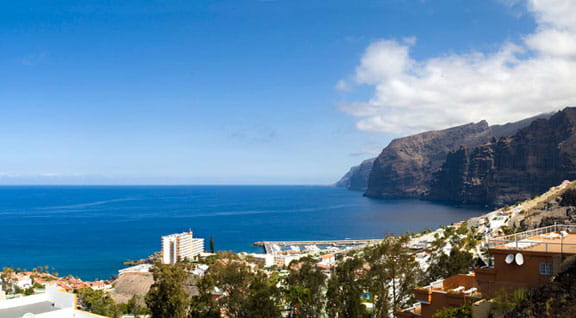
An unmistakable landmark stands out in Santiago del Teide: the cliffs of Los Gigantes, towering as high as 600 m (1,970 ft) above sea level. And the municipality has other attractions provided by the sea. There are boats leaving every day from the marina to take visitors whale and dolphin watching just a few miles out. On the coast, the beach of La Arena is one of the loveliest on the Island. The Chinyero volcano and the pottery and ethnography museum of Cha Domitila are two of the municipality's other unmissable sights.
Santiago del Teide is a municipality in south-west Tenerife that ranges from the coast of Puerto Santiago to the pine forests of Mount Teide, with a difference in altitude of 1,000 m (3,280 ft). The weather here is stable all year round, which adds to the beauty of its landscapes and the pleasant temperature of the water, making Santiago del Teide a great place to spend time in the countryside and by the sea. Up in the higher parts of the municipality, the scenery reveals a contrast between volcanic landscapes, vineyards, almond and fig trees. The Chinyero volcano, in the Special Nature Reserve of El Chinyero, was responsible for the Island's latest eruption, which took place in 1909.
Although today the economy in Santiago del Teide is largely reliant on the service sector, it was traditionally based on farming and pottery, as well as fishing. The seaside town of Puerto Santiago shares the coast with the cliffs of Los Gigantes. It has a marina and a very popular black sandy beach that has been awarded a European blue flag for its clear waters. In 1960, Juan Manuel Capdevielle discovered the scenery of the cliffs of Los Gigantes and promoted the area's urbanisation in order to boost tourism. A weather station was set up there and was used to measure a variety of aspects relating to the area's climate and sea for three years – the conclusion was that it has some of the best weather conditions in the world. Its wonderful coast welcomes several species of cetaceans to live in its waters, and visitors have the chance of seeing them on special boat trips.
Approved trails in the municipality
Trail SL-TF 60 sets off from the Pottery Centre on a 9 km (5.6 mile) walk that links Santiago del Teide to Arguayo. Along the way, hikers will see fields of almond trees, Bilma mountain and the town centre of Santiago del Teide. Although the walk itself is not too difficult, the ground is stony and considerably adds to the strain of the four-hour walk. The PR-TF 65 trail, on the other hand, journeys to Puerto Santiago starting from a broad pathway by the petrol station in Santiago del Teide. The trail leads walkers along a gulley and down a ravine near Tamaimo. The walk is intermediate in difficulty and covers 8 km (6 miles) across a very exposed landscape so be sure to take plenty of water and protect yourself from the heat and the sun.
There are other trails branching off from this route: PR-TF 65.1 (El Molledo-Risco Blanco), PR-TF 65.2 (Tamaimo-Cruz de los Misioneros) and PR-TF 65.3 (El Molledo-Degollada del Roque). Santiago del Teide's Tourist Information Office has maps available for visitors.
We answer to your frequently asked questions
Everything you need to know about Santiago del Teide
Where is Santiago del Teide?
Santiago del Teide is a municipality located in the west of Tenerife, between the Atlantic Ocean and the mid-altitude areas of the Teno massif. Its territory stretches from the coast of Los Gigantes and Puerto de Santiago to mountain villages such as Arguayo, Tamaimo and the historic centre of Santiago del Teide itself, located at approximately 900 metres above sea level. What makes this municipality special is the enormous variety of landscapes it brings together within just a few kilometres (a few miles). In a single day, you can:
- See volcanic cliffs more than 600 metres high
- Go hiking among pine forests and lava flows
- Swim on black-sand beaches
- Take a boat trip to spot dolphins and pilot whales
- Eat in small traditional restaurants in the mid-altitude areas
It is one of the areas of Tenerife where the contrast between the tourist coast and traditional rural villages can still be clearly seen.
What can you see and do in Santiago del Teide and near the village?
Santiago del Teide combines sea, mountains and local tradition, so it offers very different activities depending on the area you visit. On the coast
- The Los Gigantes Cliffs are the municipality’s great natural landmark. From the sea, the volcanic walls are even more impressive.
- Whale- and dolphin-watching trips depart from the marina all year round.
- La Arena Beach is one of the best-known black-sand beaches in Tenerife.
- You can also go kayaking, snorkelling or take short boat trips along the coast.
In the mid-altitude areas and inland villages
- The historic centre of Santiago del Teide preserves the peaceful atmosphere of traditional Tenerife villages.
- Arguayo keeps the tradition of Guanche pottery alive at the Cha Domitila Pottery Centre.
- Tamaimo and Las Manchas are excellent starting points for hiking.
Nature and hiking
- The Chinyero volcano route is one of the most popular in the municipality.
- The old caminos reales connect several historic hamlets between mountains and ravines.
- In winter, the almond trees in blossom completely transform the landscape of the area.
How do you get to Santiago del Teide?
You can get to Santiago del Teide in several ways, depending on the part of the island you are travelling from and whether you mainly want to move around the coast or also visit the mid-altitude villages.
- By car: this is the most convenient way to explore the municipality and reach places such as Los Gigantes, Playa de La Arena, Arguayo or the Chinyero volcano. From the south of Tenerife, it is easily reached via the TF-1 motorway and the TF-47 road. From the north, the usual route passes through Icod de los Vinos and the TF-82. The journey from Costa Adeje usually takes between 30 and 40 minutes. From Tenerife South Airport, located about 45 kilometres (28 miles) away, the journey usually takes approximately 35 to 45 minutes, depending on traffic and the specific area of the municipality being visited.
- By guagua, or bus: TITSA connects Santiago del Teide with different parts of the island through several regular routes. Some of the most commonly used are route 325, Puerto de la Cruz – Los Gigantes; 355, Santiago del Teide – Masca; 460, Icod de los Vinos – Costa Adeje; and 462, Guía de Isora – Los Gigantes. Connections are more frequent towards the coast than towards the mid-altitude areas. You can check updated timetables on the TITSA website.
- On foot: some hikers reach Santiago del Teide on foot via old caminos reales and routes that connect Tamaimo, El Molledo, Arguayo and the areas close to the Teno massif. Several historic routes cross the municipality and allow visitors to discover rural landscapes, ravines and volcanic areas of great natural value.
The roads in the area have quite a few bends, especially in the mid-altitude areas, but they also offer some of the most spectacular viewpoints in western Tenerife.
What is the weather like in Santiago del Teide and what is the usual temperature?
The climate in Santiago del Teide varies considerably depending on the altitude and the area of the municipality. On the coast, in places such as Los Gigantes or Playa de La Arena, mild temperatures and sunny conditions predominate for much of the year. By contrast, in the mid-altitude and higher areas such as Santiago del Teide town centre, Arguayo or Tamaimo, the climate is usually cooler, especially in winter and at sunset. Winters are mild and summers are normally warm but pleasant thanks to the influence of the ocean and the altitude. The average annual temperature usually ranges between 18 and 24 °C (64 and 75 °F), depending on the area of the municipality. You can visit Santiago del Teide at any time of year, although January and February have a special appeal because of the almond blossom in the mid-altitude areas. For hiking, spring and autumn usually offer the most pleasant conditions.
Where to stay in Santiago del Teide?
The village of Santiago del Teide is a good option for those looking for a peaceful stay in a rural area of Tenerife, away from the more touristy parts of the coast. As it is located at around 900 metres above sea level, the atmosphere is usually cooler and quieter than in Los Gigantes or Playa de La Arena. In the town centre and its surroundings, the most common options are:
- Rural houses, many of them set among volcanic landscapes, small farms and trails, ideal for switching off and enjoying nature.
- Small holiday apartments, usually quiet and designed for travellers who want to explore western Tenerife with greater freedom and flexibility.
- Family-run accommodation, with a warm and local atmosphere.
- Restored traditional homes, old Canarian houses renovated with wooden balconies, inner courtyards and views of the mountains or rural surroundings.
Many people choose to stay here to go hiking, explore the area around the Chinyero volcano or enjoy routes among almond trees and old rural paths. In addition, the village provides easy access both to the west coast and to the municipality’s mountain areas. It is a particularly recommended place for those seeking nature, disconnection and a slower pace during their trip to Tenerife.
Where to eat in Santiago del Teide?
Santiago del Teide has a very varied gastronomic offering, ranging from restaurants by the sea to small guachinches and traditional Canarian cuisine establishments. In areas such as Los Gigantes and Puerto de Santiago, you will find restaurants more geared towards visitors, many of them with terraces and ocean views. By contrast, in mid-altitude villages such as Santiago del Teide town centre, Tamaimo or Arguayo, family-run restaurants and traditional bars predominate, where you can try typical Canarian recipes. Some very common dishes in the area are:
- Papas arrugadas with mojo
- Goat meat
- Rabbit in salmorejo
- Fresh fish
- Canarian cheeses
- Gofio escaldado
There are also small guachinches and local establishments serving homemade food in a more authentic and peaceful atmosphere. Although many visitors associate guachinches with northern Tenerife, in this area you can also find family-run places with Tenerife wines, generous portions and reasonable prices. Some of these establishments only open on certain days or during specific seasons, so it is advisable to check opening times before visiting.
What hiking routes are there in Santiago del Teide?
The municipality is one of the best places in western Tenerife for hiking because it connects the coast, mid-altitude areas and mountains. Some well-known routes are:
- Chinyero volcano route: a relatively easy circular route among lava flows and pine forests, around the last volcano to erupt in Tenerife in 1909.
- Camino Real de Santiago del Teide: an old traditional path that links different rural settlements in the municipality.
- Trails between Tamaimo and Teno: there are several routes with spectacular views towards ravines and cliffs.
- Almond blossom routes: between January and February, many rural paths fill with almond trees in bloom, especially near Arguayo and Santiago del Teide.
Most trails do not require technical experience, although suitable footwear and sun protection are necessary.
Where can you see almond trees in blossom in Santiago del Teide?
The blossom usually appears between late January and February, depending on the year and the temperatures. The best areas to see it are:
- Santiago del Teide town centre
- Arguayo
- Tamaimo
- Las Manchas
During those weeks, the landscape changes completely and many hiking routes cross fields full of white and pink flowers. It is one of the most beautiful and lesser-known times to visit this part of Tenerife.
Are there beaches near Santiago del Teide?
Although the municipality is mainly known for Los Gigantes, it also has several very popular bathing areas.
- Playa de La Arena: this is the best-known beach in the municipality. It stands out for its volcanic black sand, clean water, usually moderate swell, services and accessibility.
- Playa de Los Guíos: located next to the port of Los Gigantes, it offers spectacular views of the cliffs.
- Natural pools and bathing areas: at some points along the coast there are small natural pools and volcanic bathing areas, although it is always advisable to check the sea conditions before accessing them.
What festivals are celebrated in Santiago del Teide?
Popular festivals remain very important in Santiago del Teide and are a good opportunity to discover the municipality’s more traditional atmosphere, especially in the mid-altitude villages. Among the best-known celebrations are:
- The festivities of Santiago Apóstol: celebrated around 25 July, they include processions, concerts, popular activities, fairs and open-air dances.
- The celebrations of San Fernando Rey: these combine religious and cultural events with family activities and traditional music.
- Traditional romerías: residents and folk groups parade through the streets in traditional dress, with decorated carts and Canarian music.
- Popular summer open-air dances: outdoor festivities with orchestras and live music are common, especially in the municipality’s villages.
- Sporting and cultural events: throughout the year, mountain races, hiking activities, markets and folk festivals are also organised.
If you visit the municipality during any of these dates, you will enjoy its local and traditional atmosphere.