
Garcia Sanabria Park
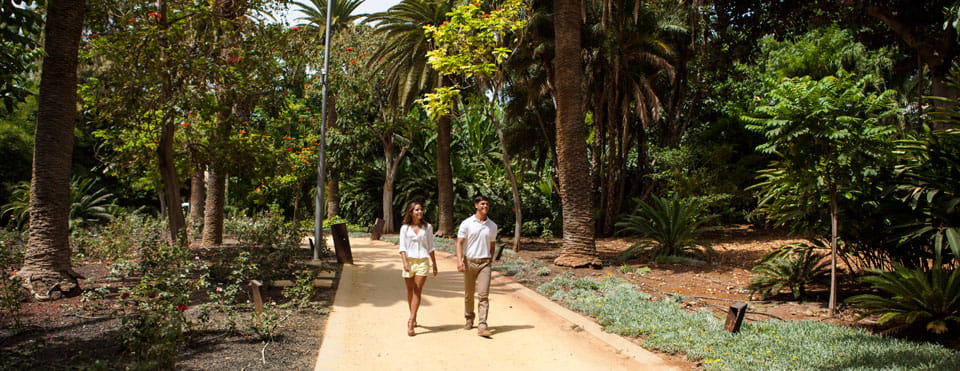
This park is one of the most emblematic symbols of Santa Cruz de Tenerife. Surrounded by tropical flowers, you will discover sculptures hidden among the trees and feel the warm rays of the sun peeking through the lush vegetation. This is something you really don't want to just hear about from somebody else – you must experience it for yourself.
Covering an expanse of 67,230 square metres (about 17 acres), the García Sanabria park houses plenty of sculptures of great artistic value, some of which were on display at the 1st International Street Sculpture Exhibition by artists such as Pablo Serrano and José Guinovart, as well as busts of some of the city's most illustrious figures, and a whole array of tropical trees and plants.
At the heart of the park stands the Monument to García Sanabria (1938), which was made by the sculptor Francisco Borges Salas and designed by the architect Marrero Regalado. Beside it is the statue of La Fecundidad (meaning The Fertility), by the same sculptor.
Opening hours: Permanently open. All year round.
Entrance price: Free.
Address
Garcia Sanabria Park
Streets Numancia, Méndez Núñez, Dr. José Naveiras and Ramblas.
We answer to your frequently asked questions
Everything you need to know about Parque García Sababria in Tenerife
What is Parque García Sanabria and how large is it?
Parque García Sanabria is one of the most emblematic green spaces in Santa Cruz de Tenerife. It serves as an urban garden, a place for walking and a cultural space, combining an extensive collection of tropical and subtropical plants with sculptures, monuments, fountains and seating areas. It covers an area of 67,230 square metres, equivalent to approximately 6.7 hectares. Its size allows visitors to explore a variety of environments, from vegetation-covered walkways to flower gardens, ponds and spaces devoted to art. The park is also listed as a Site of Cultural Interest in the Historic Garden category. This designation protects both its landscape design and the monuments and works of art associated with the site.
What is the history of Parque García Sanabria and when was it created?
The idea of building a large public park in Santa Cruz emerged in the late 19th century. Councillor Patricio Estévanez Murphy proposed the project and received the support of municipal architect Manuel de Cámara and Dr Diego Guigou. The decisive step came during Santiago García Sanabria’s time as mayor. The Pro-Parque committee raised funds through public contributions and acquired the first plots of land in 1923. Over the following years, the gardens were developed and plants from nurseries and private donations were introduced. The year 1926 is generally regarded as a key date in the creation of the park, as this was when the project received the momentum it needed to become the large green space planned for the city. Monuments, sculptures, fountains and new gardens were subsequently added, and various restoration projects were carried out. The park is named after Santiago García Sanabria in recognition of his role in implementing the project and mobilising the resources required to make it a reality.
Where is Parque García Sanabria and how do I get there?
Parque García Sanabria is located in the heart of Santa Cruz de Tenerife. It is bordered by Calles Numancia, Méndez Núñez and Doctor José Naveiras, as well as the Rambla de Santa Cruz. Its location makes it easy to combine a visit with a walk through the El Toscal neighbourhood, Plaza de los Patos, Calle del Pilar and other shopping and cultural areas of the capital. One of the most convenient options by tram is to take Line 1 and get off at Weyler. From there, you can walk along Calle Méndez Núñez for a few minutes until you reach one of the park entrances. This line connects Santa Cruz with the transport interchange and various parts of the metropolitan area. You can also get there by guagua, or bus. Routes 905 and 914 stop at Parque García Sanabria, beside the grounds. Route 905 connects the area with Muelle Norte and Ofra, while route 914 follows a circular route from the transport interchange via Plaza Weyler, Calle del Pilar and Plaza de España. Another option is route 920, which travels through central Santa Cruz and passes along the Rambla, a few minutes’ walk from the park. This route connects the transport interchange with Plaza de España, La Marina, the Rambla and Avenida Reyes Católicos. If you are travelling from another municipality, you can go to the Santa Cruz transport interchange and continue on tram Line 1 or connect with bus routes 914 or 920. As routes, frequencies and stops may be diverted during events or road closures, it is advisable to check the TITSA journey planner and service notices before setting out. If you prefer to travel by car, there are public car parks in central Santa Cruz. Parking in the streets near the park may be limited, particularly during busy periods, at weekends or when fairs and events are taking place. Thanks to its central location, you can combine your visit with Plaza de los Patos, the Rambla de Santa Cruz, the Municipal Museum of Fine Arts or the capital’s main shopping streets.
What are the opening hours of Parque García Sanabria and how much does admission cost?
Parque García Sanabria remains open at all times throughout the year. There is no need to buy a ticket or make a reservation to explore its gardens, as general admission is free. Some areas may be temporarily affected by maintenance work, event installations or work on the vegetation. The exhibition hall and other services located within the grounds have their own opening hours and are not necessarily open throughout the day.
What can you do in Parque García Sanabria and how long does the route take?
The park is an ideal place for activities such as:
- Walking
- Resting beneath the vegetation
- Photographing flowers
- Viewing sculptures
- Discovering some of Santa Cruz’s most representative monuments
You can also stop beside its ponds, explore the rose garden or visit the Flower Clock. A simple route can begin at the Flower Clock and continue towards the central monument devoted to García Sanabria. From there, you can explore the Bamboo Walk, the rose garden, the Water Lily Pond and the paths displaying sculptures from the International Street Sculpture Exhibition. The park’s design combines two large diagonal avenues, radial paths and a spiral walkway linking its different environments. As a guide, a relaxed visit can take between 45 minutes and an hour and a half. The route may take longer if you wish to read the information about the sculptures, visit a temporary exhibition or stop to rest and have something to eat or drink.
What vegetation can be found in Parque García Sanabria?
The park contains an extensive collection of ornamental plants of tropical and subtropical origin. Its most representative species include Canary Island palms, dragon trees, flamboyant trees, bougainvillea, Indian laurels and different varieties of ficus. There are also roses, cacti, cycads, arums, frangipani trees, olive trees and aromatic plants such as mint, rosemary and curry plant. One of its most unusual specimens is an old tamarind tree that was already growing on the site before planting work began in the park. Although people often refer to the cactus garden, it mainly consists of landscaped areas containing cacti and other plants adapted to dry conditions, rather than a separate botanical garden. Flowering varies according to the species and the time of year. Orchids and other delicate flowers may appear in seasonal displays or exhibitions, but their presence or flowering cannot be guaranteed during every visit. To discover a wider variety of flowers, it is advisable to check the programme of the Regional Flower and Plant Exhibition.
What sculptures and monuments can be seen in Parque García Sanabria?
The park functions as an open-air sculpture museum. Some of its works come from the first International Street Sculpture Exhibition held in Santa Cruz and include creations by Spanish and international artists. Notable pieces include:
- Homage to the Canary Islands, by Pablo Serrano
- Homage to Gaudí, by Eduardo Paolozzi
- Homage to Millares, by Claude Viseux
- Labyrinth, Homage to Borges, by Gustavo Torner
- Monument to the Cat, by Óscar Domínguez
Works by Amadeo Gabino, Josep Maria Subirachs, Remigio Mendiburu, Jesús Soto, José Guinovart and other artists can also be seen. The grounds also contain monuments dedicated to figures connected with the history of Tenerife, including Dr Diego Guigou, Leopoldo O’Donnell, Ángel Guimerá, Leonor Pérez and Francisco Borges Salas. The monument to Dr Guigou was created by Borges Salas and commemorates his work for children and medicine on the island. Along the Rose Garden Walk, there are also four female figures representing the seasons of the year. Other features can be found beside the Bamboo Walk, including the Monument to the Climate and the sculpture The Adolescent, located next to the Water Lily Pond.
Who created the central fountain and what does La Fecundidad represent?
The central monument is dedicated to Santiago García Sanabria and was designed by the architect José Enrique Marrero Regalado. The ensemble consists of stone elements, reliefs associated with work and the future, and a female sculpture that presides over the composition. This figure is La Fecundidad, a work by the Tenerife-born sculptor Francisco Borges Salas. It depicts a seated woman and symbolises fertility, life and the capacity for growth. In some publications and routes, it is also popularly referred to as La Maternidad, although its official heritage name is La Fecundidad. The illuminated fountain surrounding the monument was added later and was designed by the engineer Carlos Bohigas. The ensemble therefore does not have a single creator: Marrero Regalado designed the monument, Borges Salas created the sculpture and Bohigas worked on the fountain.
What is significant about the Flower Clock, the fountains and the park’s ponds?
The Flower Clock is one of the best-known features of Parque García Sanabria. It was made in Switzerland by the Favag company and presented to Santa Cruz by Peder Larsen, the Danish consul. It was installed in 1958, and its face is decorated with plants and flowers, meaning that its appearance can change throughout the year. One of the main water features is the illuminated fountain surrounding the monument to García Sanabria. There is also the Water Lily Pond, overlooked by the sculpture The Adolescent, as well as other ornamental fountains and water features distributed throughout the grounds. The official sources consulted do not provide a single, up-to-date count of all the fountains in the park. Some features may also remain temporarily without water because of cleaning, maintenance or repair work.
What events are held in Parque García Sanabria?
Throughout the year, the park hosts cultural activities, exhibitions, concerts, guided routes and family events. One of its best-known events is the Regional Exhibition of Flowers, Plants and Traditional Canary Islands Crafts, which is linked to Santa Cruz’s May Festivities. This celebration brings together nurseries, florists, craftspeople, workshops, children’s activities and displays related to nature. In some years, it coincides with the Santa Cruz Book Fair, which sets up stalls and organises presentations, meetings with authors and activities promoting reading. Performances by Gorgorito and the puppets of Maese Villarejo also form part of the traditional May Festivities programme. They are generally held near the Flower Clock, although the dates and times change each year. To find the current programme for the plant fair, concerts and other activities, check the official Santa Cruz events calendar before visiting.
Does Parque García Sanabria have an art and exhibition gallery?
Yes. Inside the park, there is a municipal gallery used for temporary exhibitions. This space hosts exhibitions of painting, drawing, photography, sculpture and other projects related to the visual arts. The exhibitions change throughout the year, and each one may have different opening hours. The gallery’s opening times therefore do not necessarily coincide with the park’s permanent access. Before visiting, it is advisable to check the municipal cultural events calendar to see which exhibition is available, its opening days and whether any guided visits or accompanying activities are being organised.
Is there a café in Parque García Sanabria?
The park has a kiosk-bar and a restaurant with a terrace beside the Rambla de Santa Cruz. Their availability and opening hours may differ from those of the park, so it is advisable to check that they are open before planning a particular meal or break. You will also find cafés, terraces and restaurants in the nearby streets, particularly along the Rambla, Calle Méndez Núñez and around the El Toscal neighbourhood. This makes it easy to include a walk through the park as part of a wider route around central Santa Cruz.


