Other details
Opening hours:
Tuesday to friday: 10:00- 20:00 h
Saturdays and Sundays: 10:00 - 15:00 h
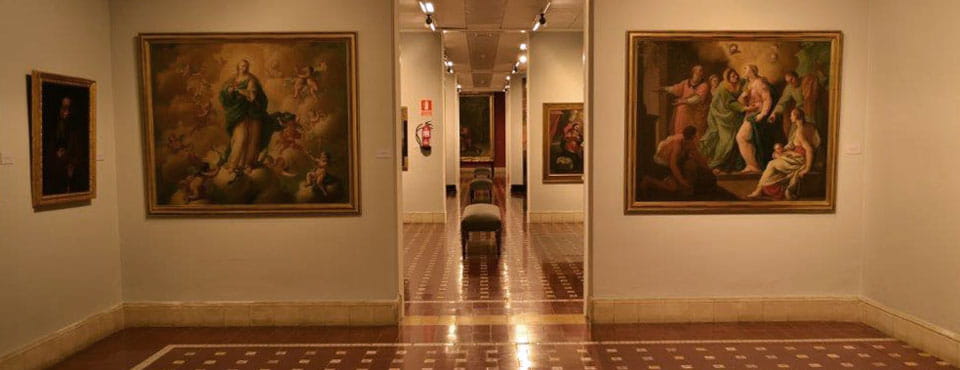
The “Museo Municipal de Bellas Artes” (Fine Art Museum) contains fourteen exhibition rooms, which hold works dating from the 16th to the 20th century. The building has a classic design and was built at the beginning of 1929 by the architect Eladio Laredo. The outside of the building is decorated with 10 busts of distinguished people from Tenerife, the most outstanding of which include: Teobaldo Power (musician and composer), Ángel Guimerá (poet and playwright), Juan de Iriarte (grammarian and writer), Antonio de Viana (poet), Villalba Hervás (historian), Bethencourt y Molina (engineer) and Valentín Sanz (painter).
The first objects to be kept and preserved here were the flags won in 1797 in the battle against Nelson. In 1840 the Town Hall ordered them to be preserved in a special place: this initiative was the beginning of the museum. In 1933 the current building was refurbished to be used as an exhibition space, as up until then, artistic works had been exhibited in the meeting rooms of the Town Hall.
Some of the most notable works that can be found in this museum are the "Triptych of Nava y Grimón" by the Flemmish painter Pieter Coecke; "San Andrés" by José de Rivera; "Orfeo" by Bueghel; a portrait of Queen Isabel II by Federico de Madrazo and works by Fernando Viscaí, Joaquín Sorolla, among many others. There are also an important number of works by Canarian artists, such as Gaspar de Quevedo, Cristóbal Hernández de Quintana, Juan de Miranda and González Méndez.
Among the many activities taking place here are guided tours of both the museum and of the patrimony of the city (Monuments of Santa Cruz, Squares and Avenues), book presentations, lectures and musical recitals.
Opening hours:
Tuesday to friday: 10:00- 20:00 h
Saturdays and Sundays: 10:00 - 15:00 h
The Museo de Bellas Artes de Tenerife is located on Calle José Murphy, beside Plaza del Príncipe, in the heart of Santa Cruz de Tenerife. Its location means that it can be reached on foot from the main shopping streets, and the visit can be combined with Plaza de España, the Church of San Francisco, the Guimerá Theatre and other nearby places of interest. By tram, you can take Line 1 and get off at either Teatro Guimerá or Weyler. From either stop, you will need to continue on foot for a few minutes to Plaza del Príncipe. Line 1 connects central Santa Cruz with the transport interchange and different parts of the metropolitan area. The most direct guagua, or bus, route is the 914, which departs from the Santa Cruz transport interchange and stops in Plaza del Príncipe itself after passing through Plaza Weyler, Méndez Núñez and Calle del Pilar. It is a convenient option if you are arriving from the bus station or from other parts of the city centre. You can also take route 920 and get off at Plaza de Isabel II, which is within easy walking distance of the museum. This route connects the transport interchange with Plaza de España, La Marina and Las Ramblas. Another option is route 904, which goes to Plaza Weyler, from where you can continue on foot to Plaza del Príncipe If you are travelling from another municipality, you can go to the Santa Cruz transport interchange and continue on route 914 or tram Line 1. As stops and routes may be diverted during festivals, processions or other events, it is advisable to check the TITSA journey planner and service notices before setting out. If you prefer to travel by car, there are public car parks in the city centre, although parking in the streets near the museum may be limited. Before visiting, check the opening hours and allow enough time to explore both the permanent galleries and the temporary exhibitions.
To request information, check the availability of guided tours or ask questions about the exhibitions, you can contact the Museo de Bellas Artes de Tenerife by telephone on +34922 609 446 or by email at reservasmuna@santacruzdetenerife.es. It is advisable to telephone in advance if you are visiting the museum with a group, require information about accessibility or wish to confirm whether a particular exhibition is open to the public. You can also consult the municipal cultural events calendar for information about temporary exhibitions, workshops, guided visits and scheduled activities. Some may require advance registration or have limited places.
The Museo de Bellas Artes de Tenerife houses an extensive collection of paintings and sculptures, with works dating from the 16th to the 20th centuries. Its galleries offer an opportunity to discover Flemish and Spanish art, as well as an important selection of work by Canary Islands artists connected with Tenerife’s artistic history. The museum divides its collections between permanent galleries, spaces for temporary exhibitions and a storage area open to visitors. The visit therefore allows you to discover both the most notable works in its collection and projects devoted to particular artists, movements and themes. It is particularly recommended for those wishing to explore the artistic heritage of Santa Cruz and understand how painting and sculpture in the Canary Islands evolved in relation to European artistic movements.
One of the best-known pieces is the Nava y Grimón Triptych, by the Flemish painter Pieter Coecke van Aelst. The museum also holds paintings such as Saint Andrew, attributed to José de Ribera; Orpheus, by Brueghel; and a portrait of Queen Isabella II painted by Federico de Madrazo. The collection also includes a work by Joaquín Sorolla devoted to Fernando Viscaí and a significant representation of Canary Islands artists such as Gaspar de Quevedo, Cristóbal Hernández de Quintana, Juan de Miranda, Valentín Sanz and González Méndez. The selection on display may vary because of loans, restoration work or the reorganisation of the galleries. Anyone particularly interested in a specific work should therefore confirm its availability with the museum before visiting.
The museum organises temporary exhibitions devoted to historical and contemporary artists, as well as projects related to painting, sculpture, photography, comics, fashion and other forms of cultural expression. These exhibitions are mainly installed in the temporary galleries on the ground floor and change throughout the year. Some are accompanied by guided visits, talks, concerts or meetings with artists and specialists. To find out which exhibitions are available during the dates of your trip, consult the Santa Cruz Cultura events calendar. Each activity lists its duration, timetable, admission conditions and whether advance registration is required.
The origins of the museum date back to the 19th century, when various initiatives were launched to create a public art collection in Santa Cruz de Tenerife. The institution began to take shape with support from the City Council and contributions from artists, collectors and cultural promoters. Pedro Tarquis Soria, Teodomiro Robayna Marrero and Eduardo Tarquis Rodríguez were among its founders. Their contributions helped form the original art collection, which was displayed publicly during the May Festivities in the foyer of what is now the Guimerá Theatre. The Tarquis family maintained a close connection with the research, conservation and promotion of Tenerife’s artistic heritage. This link is also reflected in the building known as the Tarquis Robayna Residence, which forms part of the spaces associated with the museum.
The museum occupies a Neoclassical-style building designed by the architect Eladio Laredo. Its current premises opened during the first half of the 20th century and were designed to house both the Museo de Bellas Artes de Tenerife and the Municipal Library, a pioneering concept in the cultural architecture of the Canary Islands. The façade features ten busts devoted to intellectuals, artists and prominent figures from Tenerife’s history and culture. They include Teobaldo Power, Ángel Guimerá, Juan de Iriarte, Antonio de Viana, Villalba Hervás, Agustín de Bethencourt and Valentín Sanz. These features make the building itself an important part of the visit. Before entering, it is worth taking time to look carefully at the façade overlooking Plaza del Príncipe and identify some of the figures represented.
The building was originally designed to house both the museum and the Municipal Library of Santa Cruz. The two institutions shared the premises for several decades, so the library forms part of the building’s history. However, the Central Municipal Library is no longer located inside the Museo de Bellas Artes de Tenerife. It is now housed in the TEA Tenerife Espacio de las Artes building, where it moved in 2008. Those wishing to combine art and reading can visit the museum first and then continue to TEA. Both venues are in central Santa Cruz and can easily be included in the same cultural itinerary.
General admission to the Museo de Bellas Artes de Tenerife is free. Many of its temporary exhibitions, guided visits and cultural activities are also free of charge, subject to availability. Some concerts, workshops or special events may have their own admission fee or require advance registration. It is therefore advisable to check the specific conditions of the activity you wish to attend, even though normal admission to the museum galleries is free. When an activity has limited places, it is advisable to book in advance or arrive in plenty of time, even if there is no need to purchase a ticket.
The museum’s usual opening hours are:
Between July and September, the museum closes at 2.00 pm at weekends and on public holidays. It is closed on Good Friday, 1 May, 25 December, and 1 and 6 January. Opening hours may change because of celebrations, internal work or special circumstances. Before travelling, particularly on a public holiday, check the municipal cultural information to confirm that the galleries will be open and allow enough time for your visit.
Yes, particularly for families interested in art, history or creativity. However, it is not primarily designed as a permanent interactive museum, so the visit should be adapted to each child’s age and attention span. A good approach is to select a few works, observe their colours and characters, invent stories about the scenes or look for specific details in the paintings and sculptures. A short, participatory visit is usually more enjoyable than trying to see every gallery. The museum occasionally organises family workshops and children’s activities based on play, exploration, observation and artistic creation. As these activities are not held permanently, it is advisable to check the events calendar and book when required.
Allowing between one hour and one and a half hours is generally enough to explore the main galleries at a relaxed pace. Those wishing to read the information in detail, visit a temporary exhibition or take part in a guided tour may need around two hours. The museum is located beside Plaza del Príncipe, making it easy to combine the visit with a walk along Calle del Castillo, Plaza de España, the Church of San Francisco or the Guimerá Theatre. You can also continue to TEA Tenerife Espacio de las Artes, which houses the Central Municipal Library, and visit the nearby MUNA. This combination makes it possible to organise a cultural day in Santa Cruz without travelling long distances.


