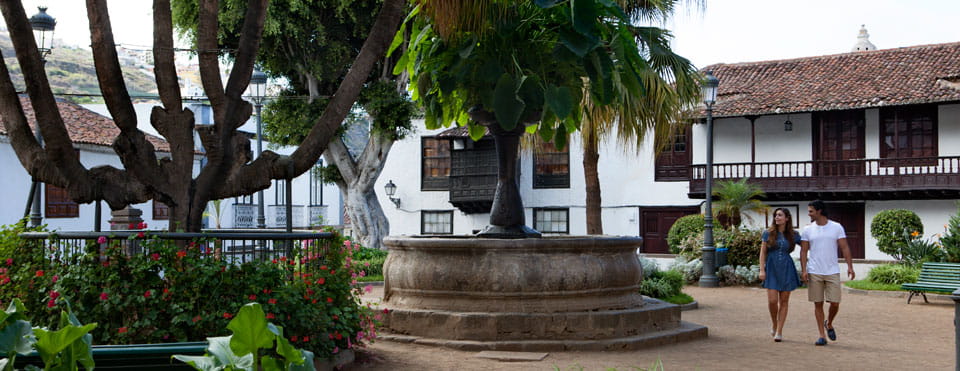
Icod de los Vinos old town
The historic quarter in Icod de los Vinos is tightly packed and very well-preserved, having been declared an Asset of Cultural Interest. Its history dates back to the late 15th century when its first buildings were erected, and it has grown gradually since then.
The sound of the water flowing from the fountain in Plaza de la Pila is mesmerising. Be warned that if you take a seat on one of its benches, under the shade of a tree, the hours will fly by without you realising. Near to the square is the park that houses the huge ancient Drago Milenario tree, one of Icod's most popular attractions.
On your tour of the town centre, don't miss the mother church of San Marcos, Plaza Andrés de Lorenzo Cáceres, the San Francisco monastery or the Emeterio Gutiérrez Albelo Museum House, as well as a string of other unmissable stops.
We answer to your frequently asked questions
Everything you need to know about the historic centre of Icod de los Vinos
How do you get to the historic centre of Icod de los Vinos?
Access to the historic centre of Icod de los Vinos is straightforward both by car and by public transport, although it is worth bearing in mind that it is an area with narrow streets and a high number of visitors at certain times of the year. By car: Parking around the historic centre can be limited, especially during high season, weekends or periods of greater tourist activity. One of the most commonly used options by visitors is the Drago Car Park, a covered parking facility located next to the Drago Park and close to the historic quarter, making it easy to reach the main points of interest on foot. Alternatively, parking spaces may also be available in streets slightly further from the centre, such as the San Antonio area. In these cases, availability may vary depending on the time of day and the number of visitors. By public transport: Icod de los Vinos has bus connections operated by TITSA, linking the municipality with different parts of the island. The main station is located on Francisco Miranda Street, from where the historic centre can easily be reached on foot in just a few minutes. Common connections include routes from northern municipalities such as Puerto de la Cruz, making it easy to visit without the need for a private vehicle.
Where is the best place to start a visit to the historic centre of Icod de los Vinos?
A convenient place to begin is Plaza de la Pila, as from there several of the main points of interest in the historic centre can easily be reached. Within a few minutes on foot, visitors can reach the Church of San Marcos, Plaza Andrés de Lorenzo Cáceres and the surroundings of the Dragon Tree.
How much time is needed to explore the historic centre of Icod de los Vinos?
For a relaxed visit, it is usual to allow between 1½ and 2 hours. If you also plan to visit the surroundings of the Dragon Tree or a cultural venue, it is advisable to allow a little more time. The historic centre is easy to explore on foot because the main points of interest are located very close to one another.
What is the best route for visiting the historic centre of Icod de los Vinos for the first time?
A very practical route can begin at Plaza de la Pila, continue towards the Church of San Marcos and then follow the streets of the historic centre until reaching the surroundings of the Dragon Tree. A balanced itinerary usually includes:
- Plaza de la Pila
- Main Church of San Marcos
- Plaza Andrés de Lorenzo Cáceres
- Convent of San Francisco
- Emeterio Gutiérrez Albelo House Museum
- Parque del Drago
This route provides a good understanding of the relationship between urban heritage and one of Tenerife’s most recognisable natural symbols.
What makes the historic centre of Icod de los Vinos special compared to other historic quarters in Tenerife?
The historic centre of Icod de los Vinos stands out because it brings together, within a compact space, several elements that clearly explain the urban history of northern Tenerife. Along the route, visitors encounter lively squares, important religious buildings, examples of traditional Canarian architecture and the surroundings of the Dragon Tree, one of the archipelago’s most recognisable natural symbols.
Which historic buildings are worth observing more closely in the historic centre?
Beyond the main route, it is worth stopping at some buildings that help explain the historical development of Icod de los Vinos, such as the Main Church of San Marcos, the Convent of San Francisco and several traditional houses with wooden balconies and volcanic stone doorways.
Is the Drago Milenario included within the route through the historic centre of Icod de los Vinos?
Yes. The surroundings of the Drago Milenario naturally form part of a visit to the historic centre because they are located very close to Plaza Andrés de Lorenzo Cáceres and several of the city’s main heritage buildings. For this reason, many visits combine both areas within the same walking route, without the need for long journeys.