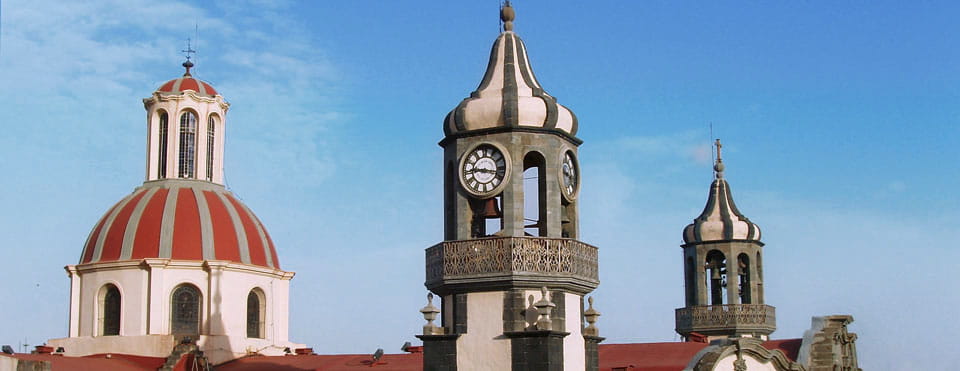
La Orotva old town
As you approach La Orotava along the northern motorway, you will soon begin to glimpse its lovely church steeples as a sample of the wonders that await you upon arrival. The old town is quaint and welcoming, with its maze of cobbled streets. A tour around this Historic-Artistic Site leads you to places such as the La Concepción church, the Calvario chapel, the church of San Agustín, the estate of Liceo Taoro or the former San Benito Abad monastery.
A great way of discovering the other side of La Orotava is by taking the Los Molinos route, which sets off from Villa de Arriba. The route takes you to the area's nine water mills that were built in the 17th and 18th century. Some still preserve the stone channels where the water used to flow.
Visiting La Orotava during the Corpus Christi celebrations is highly recommendable. On the occasion known as La Octava del Corpus, the square outside the Town Hall is adorned with a huge carpet representing religious symbols that are made of sand from Teide National Park, using 41 different colours. All around the square, the locals make fabulous painstakingly detailed carpets of flowers to adorn their streets.
We answer to your frequently asked questions
Everything you need to know about the historic centre of La Orotava
How to get to the historic centre of La Orotava?
The historic centre of La Orotava is located in the upper part of the valley and can easily be reached from the TF-5 motorway via the main access roads into the town centre. Once in the historic area, the best option is to explore it on foot, as many streets are narrow and allow visitors to better appreciate the traditional architecture. There are also regular bus connections from other municipalities in the north of the island.
How much time is needed to explore the historic centre of La Orotava?
For a relaxed first visit, it is advisable to allow between 2 and 3 hours, as the historic quarter combines monumental buildings, cobbled streets and numerous architectural details that are worth observing carefully. If you also plan to visit a museum or follow the Route of the Mills, additional time is recommended.
What is the best route for discovering the historic centre of La Orotava for the first time?
A very practical way to begin is in the area around the Church of La Concepción and continue through the streets of the old quarter where some of the city’s most representative buildings are concentrated. A typical route includes:
- Church of La Concepción
- Liceo de Taoro
- Church of San Agustín
- Streets lined with traditional manor houses
- Traditional streets of Villa de Abajo
This route offers an excellent introduction to the city’s rich heritage.
Can the historic centre of La Orotava be explored easily on foot?
Yes. Although there are uphill and downhill streets, the main route can comfortably be explored on foot. Walking also allows visitors to better appreciate some of the most characteristic features of the local architecture, such as carved wooden balconies, traditional façades, sloping tiled roofs and the stepped roofline profile that defines much of La Orotava’s historic appearance.
Is it worth visiting the historic centre of La Orotava during Corpus Christi?
Yes, because it is one of the times when the historic centre displays one of its most distinctive cultural expressions. During these dates, the Town Hall Square of La Orotava is transformed by the large volcanic sand tapestry, while the nearby streets are filled with floral carpets created by local residents. It is an experience deeply connected to the city’s historic identity.
Is the Route of the old Water Mills part of the historic centre?
Yes, because it helps visitors understand a less visible aspect of La Orotava’s urban history. This route connects with old hydraulic systems and traditional areas such as Villa de Arriba, extending the visit beyond the monumental buildings.