Other details
Opening Hours:
Garden: 9.00 a.m. - 6.00 p.m.
Closed: 1st January, Good Friday and Christmas Day
Entrance: €3.00
Library and Herbarium: 9.00 a.m. - 1.00 p.m. (Monday to Friday by appointment)
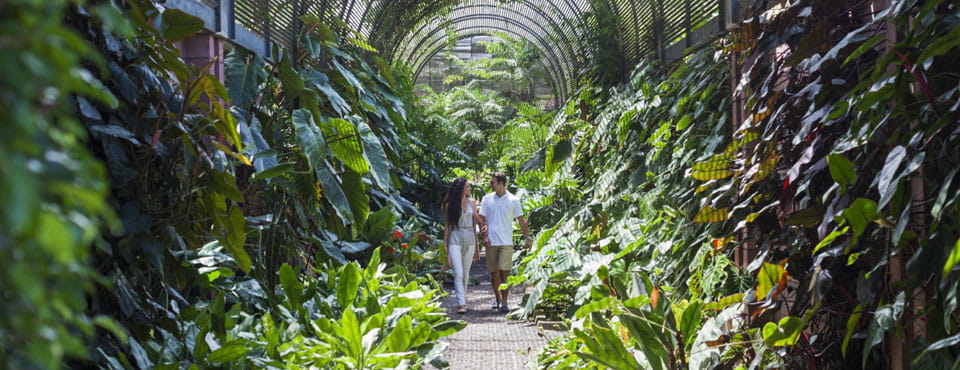
La Orotava Acclimatisation Gardens was created by Royal Order of Carlos III on the 17th of August, 1788, due to the need to cultivate species from the tropics somewhere in Spain with a suitable climate. The intervention of Alonso de Nava y Grimón, VI Marquis de Villanueva del Prado was essential both in the decision making and also to establish and develop the gardens in the early stages. In 1790, the plans and memo were drawn up and work starts on the plans drawn by Nicolás Eduardo, architect from La Laguna. In 1792, 35 new plantations are started.
French naturalist P. Ledrú, who visited the island in the late 17th century, was the first to catalogue the species grown in the Gardens. He proposed a systematic organisation of the collections based on the Linnean classification of 1753.
From 1832, the year in which Alonso de Nava, founder and first director of the Gardens, died, it has become dependent on several different agencies until 1983, when responsibility was transferred to the Canary Island Regional Government, where it came under the Research and Agrarian Technology Centre of the Regional Ministry of Agriculture and Food.
It has major collections of tropical and sub-tropical plants, with special emphasis on varieties of palms such as Bromeliacea, Araceas and Moracea. There are many plants and trees that are interesting because of their beauty, size, age, rarity or remote place of origin.
As a scientific institution, the Gardens carry out international germo-plasm exchanges, it has a herb garden specialising in native Canary flora, with more than 30,000 files and develops research programmes on the flora and vegetation of the Canary Islands and the conservation of endemic species. Ever since it was created, the Gardens have had an exhibition area of 20,000 m2, which is presently being increased, and an adjacent area of 40,000 m2.
Opening Hours:
Garden: 9.00 a.m. - 6.00 p.m.
Closed: 1st January, Good Friday and Christmas Day
Entrance: €3.00
Library and Herbarium: 9.00 a.m. - 1.00 p.m. (Monday to Friday by appointment)
Getting to the Botanical Garden of La Orotava is straightforward, especially from Puerto de la Cruz, La Orotava and other towns in the north of the island. Its excellent connections make it a convenient visit both for residents and for those exploring this part of Tenerife.
A visit to the Botanical Garden of La Orotava typically lasts between 45 minutes and an hour and a half, depending on each person's pace and their interest in stopping to observe the various plant species. It is not a particularly long visit, but it does invite you to explore the space at a leisurely pace. Those who simply wish to stroll through the garden and enjoy the atmosphere can dedicate less than an hour to it. Those with an interest in botany, the history of the site or the detailed observation of trees and exotic plants, on the other hand, tend to spend longer on the tour. For this reason, it is a very suitable option to include within a day of sightseeing in the north of Tenerife, without the need to set aside an entire day.
The history of the Botanical Garden of La Orotava dates back to the 18th century, when it was created on the initiative of the Spanish Crown with a very specific scientific objective: to acclimatise tropical and subtropical plant species from various territories in Tenerife before transferring them to the mainland. The choice of the north of Tenerife was no coincidence. The mild climate of this part of the island offered favourable conditions for testing the adaptation of plants brought from the Americas, Asia and Africa. Over time, that acclimatisation project became established as one of the most important historic botanical gardens in the Canary Islands and as a reference site for the study, conservation and display of exotic flora. Today the garden retains that heritage value and continues to be a place of interest for understanding the island's historic relationship with botany.
The function of the Botanical and Acclimatisation Garden of La Orotava has been linked since its origins to the study, conservation and adaptation of plant species. It was initially used to observe how certain tropical and subtropical plants responded to the climate of Tenerife. Over time, it also took on an educational and outreach role, allowing visitors to discover species from different continents and appreciate the importance of preserving living botanical collections. Today it combines research, conservation and the promotion of plant heritage.
The importance of the Botanical Garden of La Orotava can be understood both through its historical value and its scientific and landscape role within Tenerife. It is not merely an ornamental garden, but a space linked to botanical research, the conservation of plant species and the promotion of natural heritage. Its significance stands out for several reasons:
Furthermore, it is one of those places that allows you to discover another side of the island, one more closely connected to contemplation, science and botanical richness.
The Botanical Garden of La Orotava houses an extensive collection of tropical and subtropical flora from various continents, featuring large trees, palm trees, exotic ornamental plants and centuries-old specimens. Among the most notable species are various types of palm trees, ficus, rubber trees, magnolias, bamboos and other tropical species adapted to the climate of the north of Tenerife. Many of them stand out for their size, age and botanical value, making the tour a highly visual and enjoyable visit.
Visiting the Botanical Garden of La Orotava is well worth it because it offers a peaceful experience in a unique botanical setting within Puerto de la Cruz, where it is possible to stroll among species from different continents in a space of great historical value. The combination of exotic species, large trees and a botanical collection tied to the scientific history of Tenerife makes the visit a distinctive, enjoyable experience that is easy to combine with other nearby plans. Moreover, its layout is comfortable, allows you to enjoy the garden at a relaxed pace and does not require setting aside an entire day.
Yes, in the vicinity of the Botanical Garden of La Orotava there are restaurants, cafés and other establishments where you can eat or take a break before or after your visit. Being located in Puerto de la Cruz, the garden benefits from the gastronomic offer of one of the most well-established tourist areas in the north of Tenerife. In the surrounding area it is possible to find everything from Canarian cuisine to international options, terraces, cafés and establishments suitable for an informal meal or a quick stop. This allows you to round off your visit conveniently, without the need to travel far to find somewhere to eat.
Yes, one of the advantages of the Botanical Garden of La Orotava is that it can easily be combined with other places of interest in the north of Tenerife, particularly in Puerto de la Cruz and the surroundings of the Valle de La Orotava. Its location makes it straightforward to incorporate into a broader day of cultural, urban or scenic visits. Among the places that many people combine with this visit are:
For this reason, rather than being an isolated visit, it tends to form part of a more complete experience for discovering this part of the island at a leisurely pace.
The Botanical Garden of La Orotava offers a peaceful and accessible visit, suitable for a very wide range of visitors. It is a place recommended both for those with an interest in botany and nature, and for those looking for a relaxed stroll in a well-kept setting within Puerto de la Cruz. Its layout is comfortable for couples, families, solo travellers or visitors who wish to take a break between other tourist activities in the north of Tenerife. Furthermore, owing to its historical and scientific value, it also appeals to those who wish to discover singular spaces connected to the island's natural heritage.