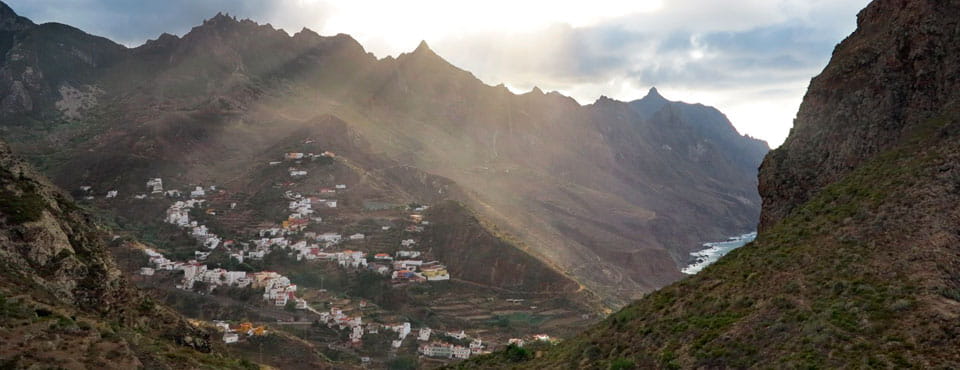
Taganana
Municipality: Santa Cruz de Tenerife
The white walls of the houses stand out brightly amidst the deep green mountains. Taganana is a disperse little hamlet inside Anaga Country Park. It is surrounded by virgin beaches and rock formations rising out of the sea just off the coast, with a mysterious yet at the same time magical air about them. A lovely panoramic photograph can be taken from the lookout point at El Bailadero.
Taganana is reached from Santa Cruz along a windy road, or alternatively from La Laguna through the laurel forests. The town is still true to the Island's traditional customs and architecture, which includes pieces such as the church of Nuestra Señora de las Nieves, one of the oldest in Tenerife. Those who visit the church enjoy taking pictures of its famous triptych painted in the 16th century Flamenco style.
There are a number of other hamlets near Taganana, so you can continue your tour along the coast towards Roque de las Bodegas along a pretty little beach. You will then come to Almáciga, a small hamlet with a long-standing farming tradition and a little chapel devoted to Nuestra Señora de Begoña, as well as its beach with large waves making it a paradise for surfers.
History has it that in the mid 20th century, a group of pilgrims from Bilbao in northern Spain threw a bottle into the sea bearing a picture of the virgin as they sailed towards Santiago de Compostela. Eight months later, the bottle was washed up on the shores of Almáciga, where the locals responded to the message. As a gift, they received a statue of the Virgin of Begoña and made her their patron saint.After Almáciga you can take the trail from there towards other recommendable hamlets. Benijo, for instance, is home to roughly two dozen inhabitants and there are records of its existence as early as 1536, when the first houses, shacks, wine cellars and even a winery were built. It once housed a chapel devoted to Santiago Apóstol dating from 1630, which unfortunately collapsed a century later and was never rebuilt. Today, you will find a number of restaurants serving Canarian cuisine that make it a great stop for replenishment.
Nearby are the hamlets of El Draguillo and Las Palmas de Anaga, with wonderful elements of traditional Canarian architecture. We would highlight the houses of Casas Principales and the adjacent chapel of San Gonzalo. This 17th century edifice features wonderful coffered ceilings, though they are in a slight state of disrepair.
The Anaga mountain range houses a great many more little settlements dotted all around. The hamlet of Chamorga has a population of less than 100 people, which is what creates much of its charm as visitors will rightfully feel like they have come to a delightfully remote location, away from the modern world. Adding to that feeling are its pretty, distinctive little houses. Further along the way is Roque Bermejo with its beach. You can also go on to explore the hamlets of Roque Negro, Afur and Taborno.
We answer to your frequently asked questions
Everything you need to know about Taganana
Where is Taganana and which municipality does it belong to?
Taganana is one of the most emblematic rural settlements in the north-east of Tenerife and administratively belongs to the municipality of Santa Cruz de Tenerife. It is located within the Anaga Rural Park massif, surrounded by steep mountains, deep ravines and the characteristic vegetation of this Biosphere Reserve area. Its location, between the sea and the slopes of Anaga, makes Taganana Tenerife one of the island’s most unique places, where a strong rural identity, traditional architecture and a close relationship with the agricultural and coastal landscape are still preserved.
What characterises Taganana?
Taganana stands out as one of the oldest villages in Tenerife and for maintaining a strong connection between landscape, agricultural tradition and coastline, something uncommon in other settlements on the island. Its hamlet, adapted to the slope of the terrain, the natural environment of Anaga, local wine cultivation, and its proximity to both forest and sea make Taganana one of the most complete and distinctive places in Tenerife. Added to this is a strong cultural identity, visible in its architecture, traditions and the way the landscape continues to shape village life.
What is the weather like in Taganana and what is the usual temperature?
The climate in Taganana is mild throughout the year, although being located in the north-east of Tenerife and within Anaga, it usually experiences more humidity and cloud cover than other parts of the island, especially in the midlands and nearby mountain areas. The weather in Taganana generally ranges between 17 and 24 °C, with pleasant temperatures almost all year round. The proximity to the sea and mountain vegetation creates a cool atmosphere, especially in winter or during the early hours of the day, making the temperature in Taganana particularly pleasant for walking or enjoying the nearby beaches in any season.
How to get to Taganana?
Getting to Taganana is one of the most scenic routes in Tenerife. The main access is from Santa Cruz de Tenerife via the TF-12 road towards Anaga, later connecting with the well-known Taganana road, the TF-134, which descends through mountains and viewpoints towards the village. – From Santa Cruz de Tenerife: around 30 minutes. – From Tenerife North Airport: approximately 35 minutes. – From Tenerife South Airport: around 1 hour and 15 minutes. The Taganana road is known for its curves and open views towards the coastline and the Anaga massif, making the journey itself part of the experience. It is also possible to reach the village by public transport using TITSA bus line 946, which connects Santa Cruz with Taganana through Anaga, providing convenient access to the village and its nearby beaches.
What to see in Taganana?
Taganana preserves some of the most representative landscapes of rural northern Tenerife and several highly recognisable points of interest. Among the most notable places are: – The Church of Nuestra Señora de las Nieves, one of the most important historic churches in the north of the island, closely linked to devotion to the Virgen de las Nieves of Taganana. – The traditional hamlet itself, with narrow streets and houses adapted to the mountainous terrain. – The natural viewpoints in the surrounding area, offering some of the best views over Taganana and the Anaga coastline. – The agricultural terraces where part of the well-known Taganana wine is still cultivated. Altogether, the area allows visitors to discover one of the villages with the strongest scenic and heritage character in north-eastern Tenerife.
What to do in Taganana?
Taganana allows visitors to combine nature, gastronomy, hiking and coastline in a single trip, which explains why it remains one of the most visited rural settlements in north-eastern Tenerife. Its location between mountains and sea makes it possible to enjoy very different landscapes within just a few kilometres and to experience the traditional character of Anaga. It is common to explore the historic centre, stop at natural viewpoints, visit nearby beaches, take hiking routes through the Anaga Rural Park or enjoy local cuisine in traditional restaurants by the coast. Many visitors also take the opportunity to discover nearby hamlets or admire the agricultural landscape where vines are still cultivated on steep slopes. Thanks to its diversity of landscapes and accessibility, Taganana is also highly valued by those looking for a peaceful excursion in north-eastern Tenerife or outdoor activities with children, especially on days combining walking, beach visits and gastronomic stops.
What trails and routes are there in Taganana?
Taganana is one of the main starting points for trails within the Anaga Rural Park, with traditional paths that allow visitors to discover some of the most characteristic landscapes of north-eastern Tenerife. Among the best-known routes are: – Taganana – Afur – Tamadite trail, one of the most complete routes in the area, connecting the village with the hamlet of Afur through ravines, old agricultural paths and areas of native vegetation before reaching the coast at Tamadite. – Taganana – Almáciga – Benijo route, highly appreciated by those wishing to combine walking and coastline, passing through small traditional settlements while enjoying continuous sea views and views of the beaches of north-eastern Tenerife. – Taganana – El Bailadero trail, an uphill route leading into the higher areas of Anaga and connecting with laurel forest zones, where the landscape gradually changes from the coastal environment to humid mountain forest. – Las Vueltas de Taganana, one of the most recognisable sections of the historic access to the village, made up of bends and old paths descending between steep slopes and offering some of the most characteristic views of the Anaga landscape. This area is highly appreciated both by hikers and by those travelling along the scenic road to the hamlet. – Traditional path to Roque de las Bodegas, ideal for a shorter walk, with easy access and open coastal views, frequently used by visitors wishing to explore the area without tackling major elevation changes. Many of these trails preserve historic routes used for centuries to connect the hamlets of Anaga, adding significant cultural value to the experience. The Taganana route is particularly appreciated because it combines sea, mountains, vegetation and rural heritage within a single journey, with options of varying difficulty for short walks or longer excursions.
What flora and fauna can I see in Taganana?
The surroundings of Taganana form part of the Anaga Rural Park, one of the areas with the greatest biodiversity in Tenerife, making the flora and fauna of Taganana one of its main natural attractions. In the more humid areas near the village, species typical of laurel forest can be found, such as laurels, fayas, heathers and ferns, especially along trails climbing towards the higher parts of Anaga. On the more open slopes near the coast, spurges, cardons and vegetation adapted to volcanic terrain and maritime influence predominate. As for wildlife, it is common to observe birds such as blackbirds, kestrels, shearwaters and small species associated with forest and coastal environments. Reptiles native to the Canary Islands and a wide variety of insects linked to this protected ecosystem can also be found in nearby ravines and coastal areas, making Taganana particularly interesting for nature lovers and landscape observers.
What beaches are there in Taganana?
The beaches of Taganana are among its main attractions and are located just a few minutes from the main settlement, along the coast of the Anaga Rural Park, where the landscape combines open sea, cliffs and volcanic formations characteristic of north-eastern Tenerife. Among the best known are: – Playa de Benijo, highly appreciated for its views of the sea stacks, its sunsets and the wild landscape surrounding it, making it one of the most recognisable images of Anaga. – Playa de Almáciga, popular with surfers and visitors thanks to its constant waves and natural Atlantic setting. – Playa de Roque de las Bodegas, one of the most accessible and best-known beaches in the area, located next to small restaurants where visitors often stop after swimming or walking along the coast. These beaches of Taganana combine dark volcanic sand, strong waves and a very distinctive natural environment, so it is advisable to take extra care when swimming and always check sea conditions, especially on days of strong tides.
Can I surf on the beaches of Taganana?
Yes, the beaches of Taganana are among the best-known surfing spots in north-eastern Tenerife, especially Playa de Almáciga and certain sections of Playa de Benijo, where Atlantic waves provide good conditions throughout much of the year. For this reason, Taganana frequently attracts local surfers and visitors looking for a less urbanised natural setting. The area also occasionally offers beginner surfing activities and surf schools operating on different beaches in Anaga, especially on days with favourable conditions.
Where to eat in Taganana?
Taganana has several restaurants and eateries well known for their traditional Canarian cuisine, especially around the coastline and near Playa de Roque de las Bodegas. It is possible to find restaurants in Taganana specialising in fresh fish, potatoes, cheeses, local wine and traditional recipes from northern Tenerife, often served on terraces overlooking the sea or the Anaga landscape. There are also small establishments nearby with a guachinche atmosphere, strongly connected to local produce and Taganana wine, which remains one of the area’s most representative gastronomic elements.
Are there wineries and traditional wine in Taganana?
Taganana maintains a strong historical connection with vine cultivation, and Taganana wine has formed part of the village’s traditional agricultural identity for centuries. On the slopes surrounding the settlement, terraces are still preserved where local grape varieties adapted to the steep terrain are cultivated. Although many vineyards are small, some wineries and producers in the area continue to keep this winemaking tradition alive, closely linked to the Anaga landscape and the agricultural history of north-eastern Tenerife.
Where to stay in Taganana?
Taganana offers small rural houses, hostels, traditional accommodation and rural tourism options integrated into the Anaga landscape, highly appreciated by those seeking a peaceful stay in one of Tenerife’s most unique natural environments. Accommodation in Taganana Tenerife is generally aimed at visitors wishing to stay surrounded by mountains, close to the sea and away from the busiest tourist areas. Many of these houses preserve elements of traditional architecture and provide easy access both to hiking trails and to the beaches of the north-east of the island.
What festivals are celebrated in Taganana?
Taganana maintains a strong festive tradition linked to the Church of Nuestra Señora de las Nieves and to the local devotion that has historically shaped village life. The main celebration revolves around the Virgen de las Nieves, with religious ceremonies, processions and popular festivities deeply rooted in the local festive calendar. During these dates, the village brings together residents and visitors around traditional activities, music and community gatherings that keep an important part of Taganana’s cultural identity alive. In addition, throughout the year cultural events and traditional activities linked to the rural environment of Anaga are also held, reinforcing the historic and community character of the settlement.